Journal of Neurology Research, ISSN 1923-2845 print, 1923-2853 online, Open Access
Article copyright, the authors; Journal compilation copyright, J Neurol Res and Elmer Press Inc
Journal website https://jnr.elmerpub.com

Original Article

Volume 15, Number 4, December 2025, pages 172-181


Mortality Following Intracerebral Hemorrhage After Intravenous Alteplase in Acute Ischemic Stroke: A Decision Tree-Based Classification Approach

Figures

Figure 1.
Figure 1. Post-alteplase intracerebral hemorrhage classified by radiographic classifications: (a) hemorrhagic infarction type 1 (HI1), (b) hemorrhagic infarction type 2 (HI2), (c) parenchymal hematoma type 1 (PH1), and (d) parenchymal hematoma type 2 (PH2). Illustration drawn and modified from the original reference [16].
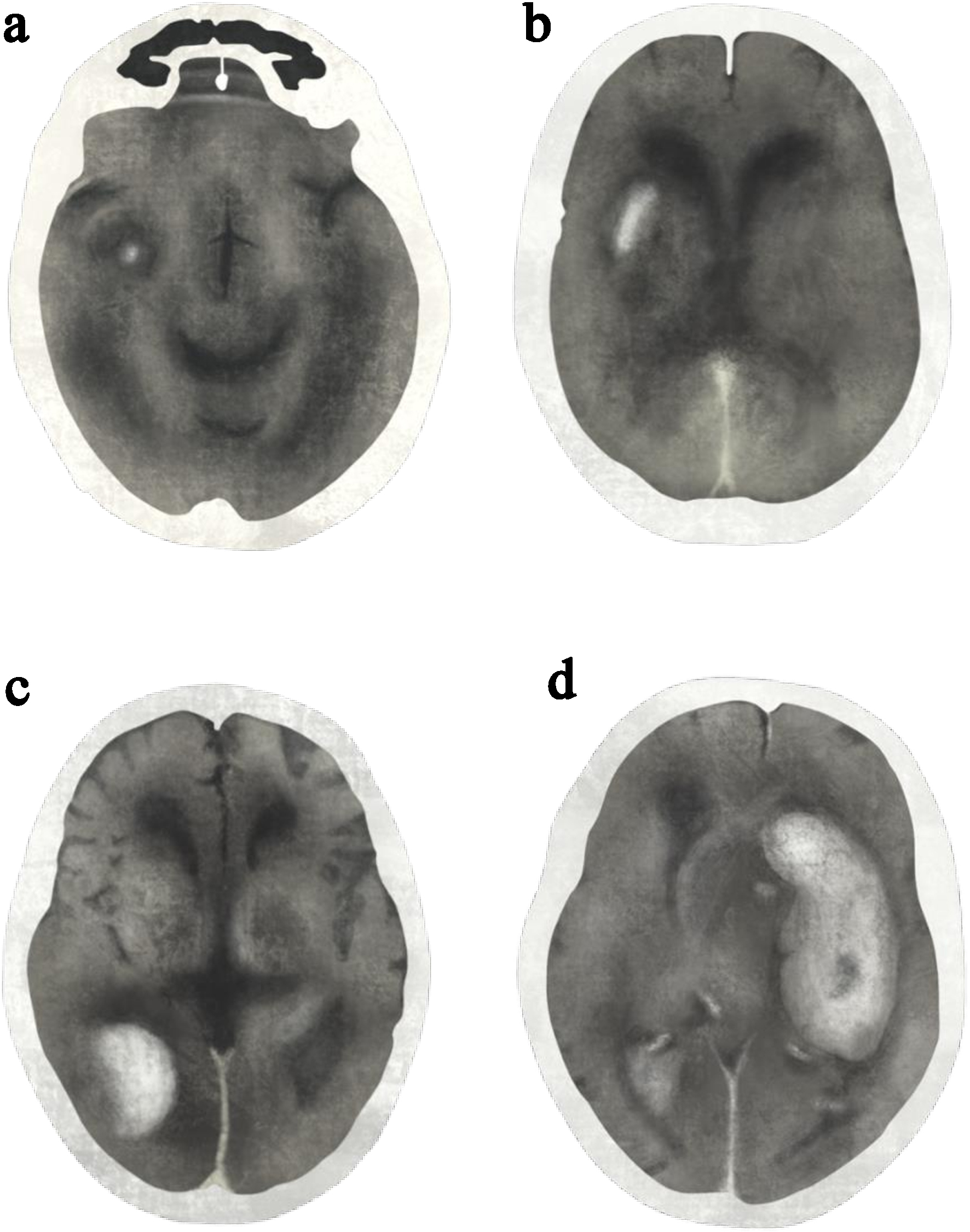
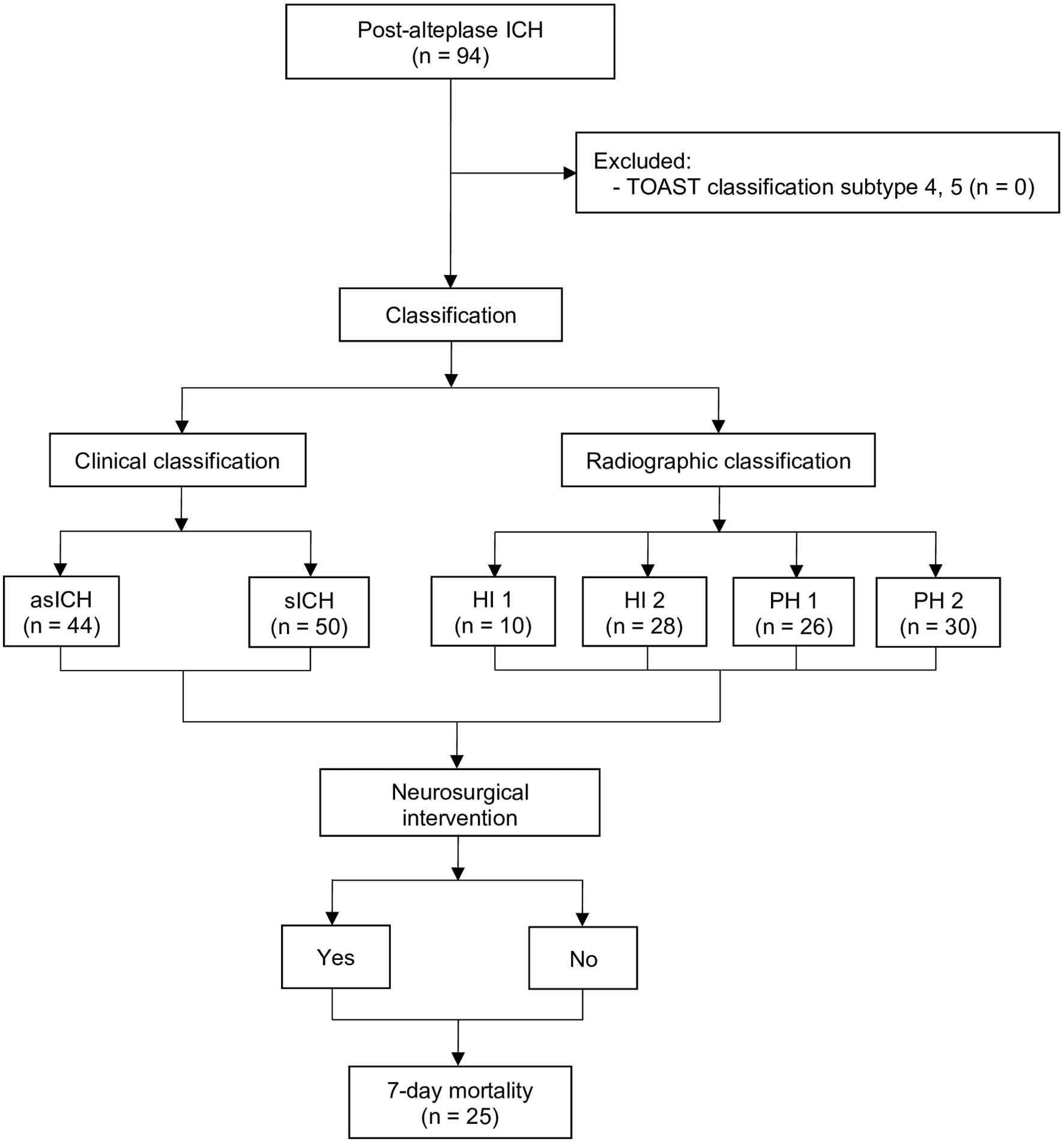
Figure 2.
Figure 2. Study flow diagram. asICH: asymptomatic intracerebral hemorrhage; HI: hemorrhagic infarction; ICH: intracerebral hemorrhage; PH: parenchymal hematoma; sICH: symptomatic intracerebral hemorrhage; TOAST: Trial of Org 10172 in Acute Stroke Treatment.
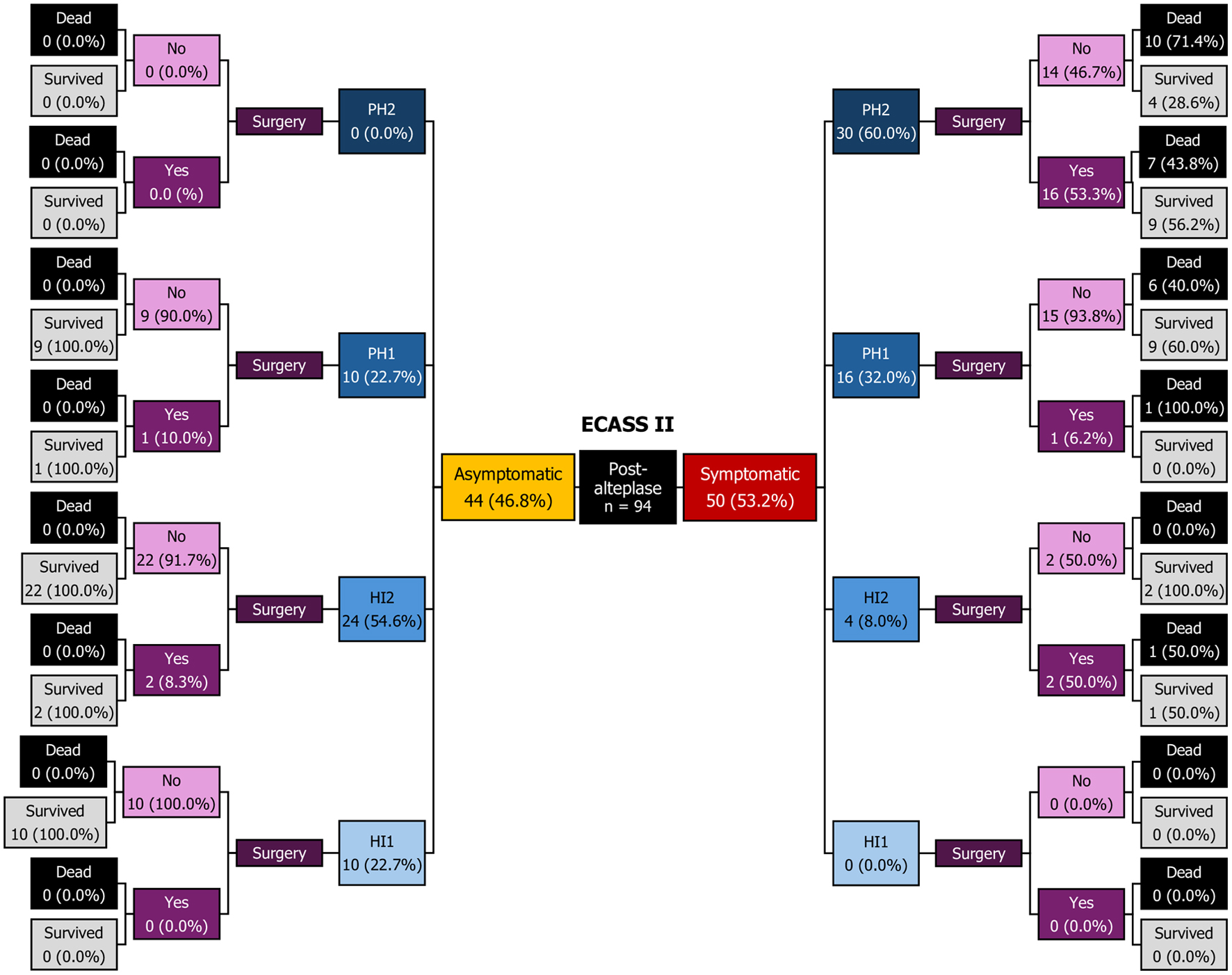
Figure 3.
Figure 3. Decision tree diagram. ECASS II: European Cooperative Acute Stroke Study II; HI: hemorrhagic infarction; PH: parenchymal hematoma; Sx: surgery.

Tables

Table 1. Baseline Characteristics of Patients With Post-Alteplase Intracerebral Hemorrhage Stratified by Survival Status
 
Baseline characteristicsDead (n = 25), n (%)Survived (n = 69), n (%)P value
IQR: interquartile range; NIHSS: National Institutes of Health Stroke Scale; SD: standard deviation.
Male12 (48.0)34 (49.3)0.376
Age (years), mean ± SD72.1 ± 8.964.9 ± 11.10.003
NIHSS, median (IQR)14 (11, 20)12 (8, 16)0.022


Table 2. Radiographic Classifications of Post-Alteplase Intracerebral Hemorrhage Stratified by Survival Status
 
Radiographic classificationsDead (n = 25), n (%)Survived (n = 69), n (%)P value
HI: hemorrhagic infarction; PH: parenchymal hematoma.
HI10 (0)10 (14.5)0.044
HI21 (4.0)27 (39.1)0.001
PH17 (28.0)19 (27.5)0.962
PH217 (68.0)13 (18.9)< 0.001


Table 3. Clinical Classifications of Post-Alteplase Intracerebral Hemorrhage Stratified by Survival Status
 
Clinical classificationsDead, n (%)Survived, n (%)P value
asICH: asymptomatic intracerebral hemorrhage; ECASS II: European Cooperative Acute Stroke Study II; mSITS-MOST: modified Safe Implementation of Thrombolysis in Stroke-Monitoring Study; NINDS: National Institute of Neurological Disorders and Stroke; sICH: symptomatic intracerebral hemorrhage.
NINDS
  asICH0 (0)43 (100)0.886
  sICH25 (49.0)26 (51.0)
ECASS II
  asICH0 (0)44 (100)1.000
  sICH25 (50.0)25 (50.0)
mSITS-MOST
  asICH1 (2.2)44 (97.8)0.889
  sICH24 (49.0)25 (51.0)


Table 4. Proportion of Symptomatic and Asymptomatic Intracerebral Hemorrhages Across Clinical Definitions
 
DefinitionsNINDS (n = 94), n (%)ECASS II (n = 94), n (%)mSITS-MOST (n = 94), n (%)P value
asICH: asymptomatic intracerebral hemorrhage; ECASS II: European Cooperative Acute Stroke Study II; mSITS-MOST: modified Safe Implementation of Thrombolysis in Stroke-Monitoring Study; NINDS: National Institute of Neurological Disorders and Stroke; sICH: symptomatic intracerebral hemorrhage.
asICH43 (45.7)44 (46.8)45 (47.9)0.958
sICH51 (54.3)50 (53.2)49 (52.1)


Table 5. Surrogates’ Decisions and 7-Day Mortality According to Neurosurgeon’s Suggestion
 
Surrogates’ decisionsNeurosurgeon’s suggestion
Conservative management (n = 10), dead/total (%)Neurosurgical intervention (n = 20), dead/total (%)
In each cell, the numerator indicates the number of deaths and the denominator indicates the total number of patients within that stratum, with the percentage shown in parentheses. NA: not applicable.
Complied6/10 (60.0%)7/16 (43.8%)
Refused0/0 (NA)4/4 (100%)
-P = 0.043


Table 6. Comparison of NIHSS Categories Across Radiographic Classifications Between Lampang and Saraburi Cohorts
 
NIHSSHI1, n (%)HI2, n (%)PH1, n (%)PH2, n (%)
HI: hemorrhagic infarction; NIHSS: National Institutes of Health Stroke Scale; PH: parenchymal hematoma.
Lampang cohort (n = 94)n = 10n = 28n = 26n = 30
  4 - 1510 (100)20 (71.4)13 (50.0)17 (56.7)
  16 - 200 (0)5 (17.9)10 (38.5)7 (23.3)
  > 200 (0)3 (10.7)3 (11.5)6 (20.0)
Saraburi cohort (n = 81) [21]HI1 + HI2 (n = 38)n = 17n = 26
  4 - 1523 (60.5)9 (52.9)5 (19.2)
  16 - 2010 (26.3)5 (29.4)15 (57.7)
  > 205 (13.2)3 (17.7)6 (23.1)