Journal of Neurology Research, ISSN 1923-2845 print, 1923-2853 online, Open Access
Article copyright, the authors; Journal compilation copyright, J Neurol Res and Elmer Press Inc
Journal website https://jnr.elmerpub.com

Review

Volume 16, Number 1, March 2026, pages 1-8


Pediatric Facial Nerve Palsy: A Narrative Review of Etiology, Diagnosis, and Management

Figure

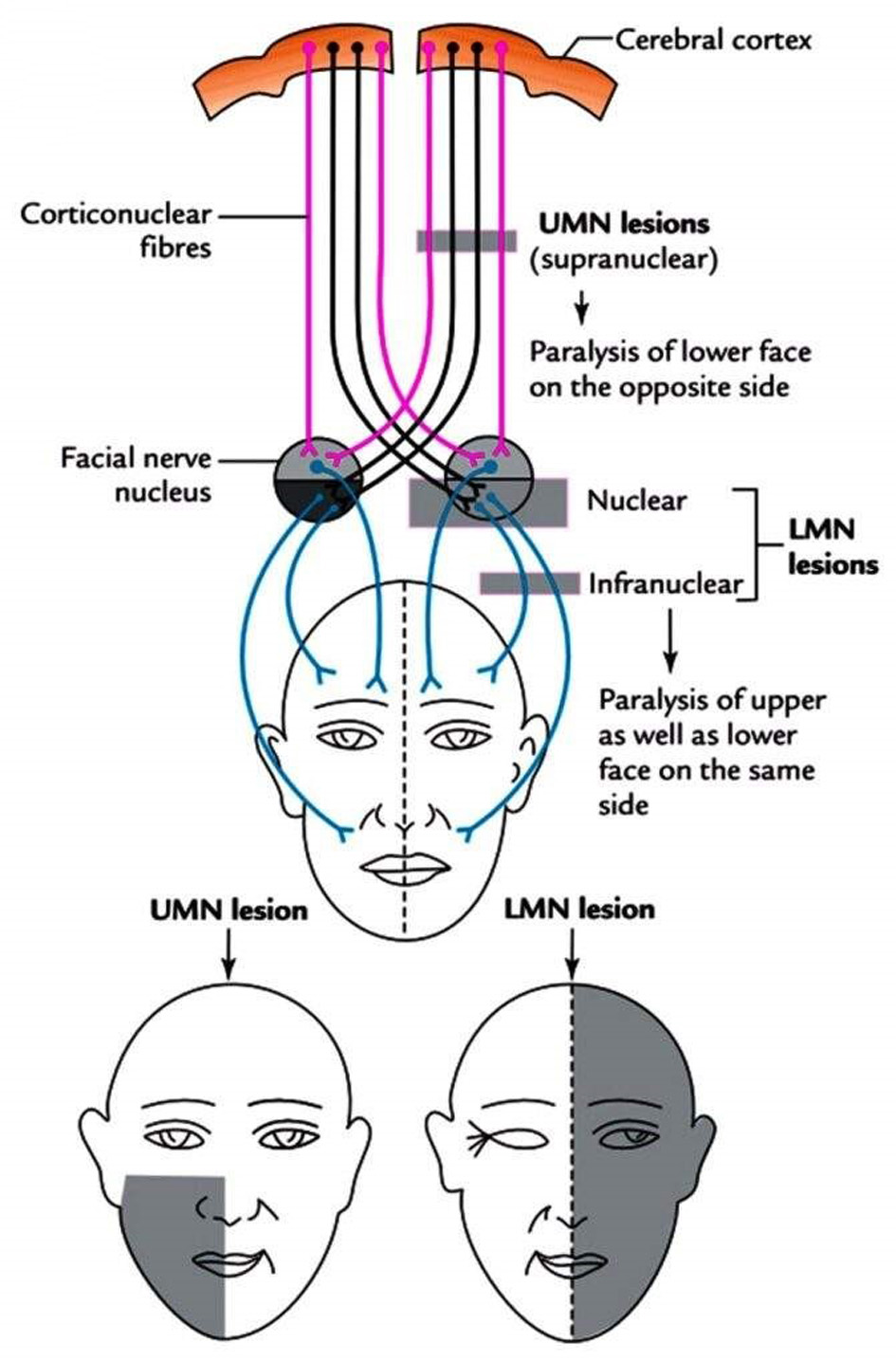
↓  Figure 1. Schematic representation of upper motor neuron (central) and lower motor neuron (peripheral) facial palsy patterns. The figure illustrates basic anatomical and clinical differences relevant to initial neurological assessment (Photo by Dr. Rahul Bagla ENT Textbook, used with permission).
Figure 1.

Tables

↓  Table 1. The House-Brackmann Grading System
 
GradeDescriptionCharacteristics
INormalNormal facial function in all areas.
IIMild dysfunctionGross: Slight weakness noticeable only on close inspection; may have very slight synkinesis.
At rest: Normal symmetry and tone.
Motion:
– Forehead: Moderate to good function.
– Eye: Complete closure with minimum effort.
– Mouth: Slight asymmetry.
IIIModerate dysfunctionGross: Obvious but not disfiguring difference between two sides; noticeable but not severe synkinesis, contracture, or hemifacial spasm.
At rest: Normal symmetry and tone.
Motion:
– Forehead: Slight to moderate movement.
– Eye: Complete closure with effort.
– Mouth: Slight weakness with maximum effort.
IVModerately severe dysfunctionGross: Obvious weakness and/or disfiguring asymmetry.
At rest: Normal symmetry and tone.
Motion:
– Forehead: None.
– Eye: Incomplete closure.
– Mouth: Asymmetric with maximum effort.
VSevere dysfunctionGross: Only barely perceptible motion.
At rest: Asymmetry.
Motion:
– Forehead: None.
– Eye: Incomplete closure.
– Mouth: Slight movement.
VITotal paralysisNo movement in any region.


↓  Table 2. Major etiologies of pediatric facial nerve palsy according to age, clinical presentation, and evidence level
 
EtiologyTypical age groupClinical presentationKey diagnostic cluesRepresentative referencesLevel of evidence (CEBM)
Bell’s palsy (idiopathic)Older children, adolescentsAcute unilateral peripheral FNP, partial > completeNo systemic illness, rapid onset, favorable prognosis[1, 3, 7]III
Birth-related (postpartum) palsyNeonatesFacial asymmetry during crying/feedingHistory of difficult or instrumental delivery[4, 15]IV
Congenital/syndromic (MBS)Neonates, infancyBilateral facial weakness, ophthalmoplegiaAbsence of recovery, craniofacial anomalies[9, 16]IV
Infectious (Lyme disease, EBV)Infants, childrenAcute unilateral or bilateral palsy ± systemic symptomsTick exposure, fever, rash, lymphadenopathy[17, 21, 22]III
Otitis media–relatedInfants, young childrenFacial palsy with ear symptomsOtalgia, fever, otoscopic findings[23]IV
Guillain–Barré syndromeChildren, adolescentsBilateral or sequential palsy ± limb weaknessAreflexia, progressive symptoms[23–25]III
Traumatic/iatrogenicAll pediatric agesImmediate or delayed palsyHead trauma, temporal bone fracture, surgery[8, 26, 27]IV
Neoplastic/structuralRare (all ages)Progressive or recurrent palsyLack of recovery, additional neurological signs[14, 28]IV


↓  Table 3. Management of Pediatric Facial Nerve Palsy: Indication-Based Approach
 
Etiology/scenarioRecommended managementWhen to consider treatmentWhen NOT recommendedKey references
Bell’s palsy – partial palsyObservation, eye careMild weakness (HB II–III), early improvementRoutine steroids or antivirals[3, 7]
Bell’s palsy – moderate/severeCorticosteroids (short, weight-adjusted course)Initiation ≤ 72 h, HB IV–VDelayed presentation, mild palsy[7, 29]
Bell’s palsy – antiviralsNot routineSelected cases with strong viral suspicionMonotherapy or routine use[30, 31]
Lyme disease–associated palsyAntibiotic therapyEndemic area, positive serologyDelayed treatment[17, 22]
GBS with facial palsyIVIG or plasmapheresisBased on neurological severityFacial palsy alone[23, 25]
Traumatic palsySurgical consultationEvidence of nerve disruptionIncomplete palsy with recovery[8, 26]
PhysiotherapyTargeted facial exercisesDelayed recovery, residual weaknessRoutine early use in mild cases[26, 33]
Electrical/laser stimulationNot routinely recommendedExperimental settings onlyRoutine pediatric use[34, 35]