Journal of Neurology Research, ISSN 1923-2845 print, 1923-2853 online, Open Access
Article copyright, the authors; Journal compilation copyright, J Neurol Res and Elmer Press Inc
Journal website https://jnr.elmerpub.com

Case Report

Volume 16, Number 4, December 2026, pages 270-281


Multimodal Neurological Assessment and Targeted Rehabilitation Following Motor Vehicle Collision-Induced Mild Traumatic Brain Injury: A Case Report

Figure

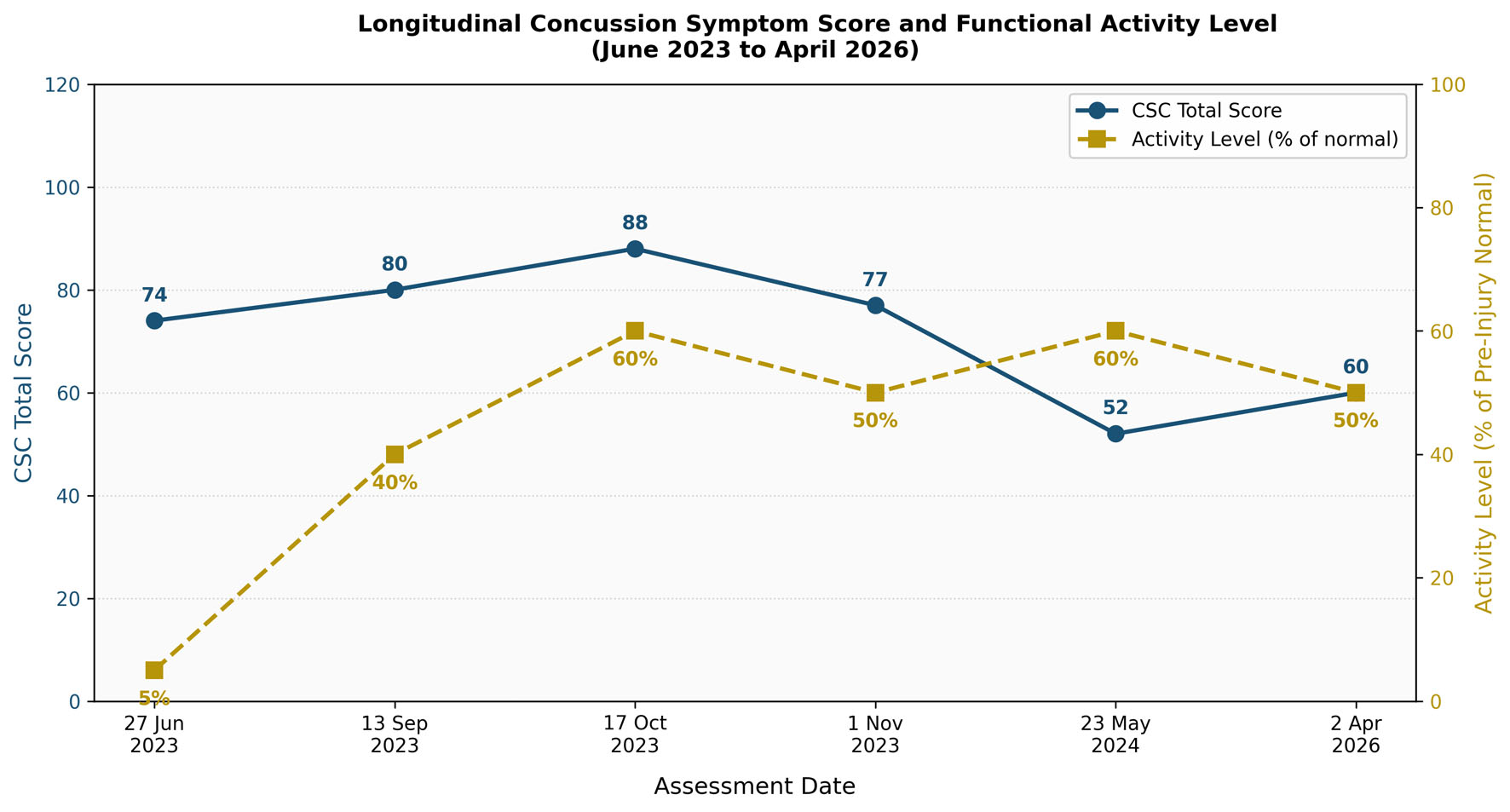
↓  Figure 1. Longitudinal trajectory of concussion symptom burden and functional activity level from initial post-injury assessment to final documented follow-up. The primary y-axis (left) displays total Concussion Symptom Checklist (CSC) scores (scale 0–132, with higher scores indicating greater symptom burden). The secondary y-axis (right) displays self-reported functional activity level as a percentage of pre-injury normal. Data points represent documented assessment dates: June 27, 2023, September 13, 2023, October 17, 2023, November 1, 2023, May 23, 2024, and April 2, 2026. Note: The July 31, 2023 data point is excluded from graphical representation due to a suspected data recording artifact in the source document, as noted in the manuscript text. The overall trajectory demonstrates gradual, non-linear reduction in symptom burden and progressive, though incomplete, recovery of functional activity level over the approximately 34-month follow-up period.
Figure 1.

Tables

↓  Table 1. Clinical Timeline Documenting Key Events, Assessments, and Findings From the Date of Injury (June 14, 2023) Through the Most Recent Documented Follow-Up (April 2, 2026)
 
DateEvent/assessmentKey finding or outcome
Events are presented in chronological order. ADL: activities of daily living; ACE: Acute Concussion Evaluation; CSC: Concussion Symptom Checklist; DHI: Dizziness Handicap Inventory; DTI: diffusion tensor imaging; DUD: Functional Disability Assessment; EEG: electroencephalography; FA: fractional anisotropy; GAD-7: Generalized Anxiety Disorder-7; HIT-6: Headache Impact Test-6; HRV: heart rate variability; MMSE: Mini Mental State Examination; MRI: magnetic resonance imaging; PCL-5: PTSD Checklist for DSM-5; PHQ-9: Patient Health Questionnaire-9; PSS: Perceived Stress Scale; ROI: region of interest; SAC: Standardized Assessment of Concussion; SWI: susceptibility-weighted imaging; UPSIT: University of Pennsylvania Smell Identification Test.
June 14, 2023Motor vehicle collision (rear-end impact by dump truck)Immediate onset of headache, nausea, dizziness, visual disturbance, cognitive fog, light sensitivity
June 14, 2023Emergency department evaluation (HCA Florida West End)Cervical and thoracic X-rays, CT neck; no acute fracture or intracranial abnormality identified; no concussion diagnosis at ED
June 21, 2023Initial chiropractic and clinical evaluationExtensive cervical and lumbar examination findings; concussion symptom score 72; pain management assessment initiated
June 21, 2023Work status documentationRestricted duty/off work initiated
June 27, 2023CSCTotal symptom score: 74; activity level 5% of normal
July 5, 2023ACE symptom checklist; MMSE; CNS-LS; Epworth Sleepiness ScaleACE total: 21 (all cognitive and emotional domains fully endorsed); MMSE 30/30; CNS-LS 17 (above PBA threshold)
July 12, 2023C3Logix cognitive performance testingAbnormal; symptom severity 76/162; SAC 19/30; simple reaction time 403 ms; Trail Making B 64.0 sec
July 19, 2023HRV assessmentLow HRV; 111% arousal increase from baseline; elevated sympathetic response; impaired post-stress recovery
July 26, 2023Quantitative pupillometry; RightEye oculometric assessmentAbnormal pupillometry (absent 75% recovery time); Saccades score 17; Pursuits score 40; EyeQ 39
July 31, 2023Cervical and lumbar spine MRICervical disc herniations C3-C4, C4-C5, C5-C6, C6-C7; straightening of cervical and lumbar lordosis; craniocervical ligaments normal
July 31, 2023CSCTotal symptom score documented (data recording artifact noted; not clinically interpreted)
August 1, 2023BrainCheck neurocognitive; WAVi EEG; BTrackS posturography; UPSIT olfactory; DHI; GAD-7; HIT-6; PCL-5; PHQ-9; PSSBrainCheck combined 54/200 (first percentile); EEG P300 voltage 3.1 µV (markedly reduced); brain age equivalent 56 years; posturography bottom quartile (2/4 conditions); UPSIT 30/40 (moderate microsmia); DHI 62 (severe); HIT-6 70 (class IV); PCL-5 43 (above threshold); PHQ-9 11 (moderate); GAD-7 10 (moderate); PSS 31 (high)
September 13, 2023CSCTotal symptom score: 80; activity level 40% of normal
September 15, 2023Brain MRI with DTI and SWIAbnormal DTI: 2/12 ROI and 2/6 white matter tracts with significantly decreased FA (> 95% probability axonal shearing injury); left internal capsule genu 10.3% lower than right; focal subcortical gliosis left parietal lobe
October 17, 2023CSC; DUDCSC total: 88; activity level 60% of normal; extensive functional limitations across work, home, exercise, and ADL domains
November 1, 2023CSC; Pain Management AssessmentCSC total: 77; activity level 50% of normal; pain scores moderate to severe in cervical, thoracic, and lumbar regions
May 23, 2024CSC; Pain Management Assessment; DUDCSC total: 52; activity level 60% of normal
April 2, 2026CSC; Pain Management AssessmentCSC total: 60; activity level 50% of normal; persistent symptoms including headache, dizziness, cognitive fog


↓  Table 2. Summary of Multimodal Diagnostic Findings Organized by Assessment Domain
 
Assessment domainInstrument/testKey findingInterpretation
Each row presents the assessment domain, the specific instrument or test used with date of administration, the key quantitative or qualitative finding, and the clinical interpretation. CNS-LS: Center for Neurologic Study-Lability Scale; DHI: Dizziness Handicap Inventory; DTI: diffusion tensor imaging; EEG: electroencephalography; FA: fractional anisotropy; GAD-7: Generalized Anxiety Disorder-7; HIT-6: Headache Impact Test-6; HRV: heart rate variability; mTBI: mild traumatic brain injury; PCL-5: PTSD Checklist for DSM-5; PHQ-9: Patient Health Questionnaire-9; PSS: Perceived Stress Scale; ROI: region of interest; SAC: Standardized Assessment of Concussion; SWI: susceptibility-weighted imaging; UPSIT: University of Pennsylvania Smell Identification Test.
NeurocognitiveC3Logix (July 12, 2023)Symptom severity 76/162; SAC 19/30; reaction time 403 ms; Trail Making B 64.0 sAbnormal; consistent with mTBI
NeurocognitiveBrainCheck (August 1, 2023)Combined score 54/200 (first percentile); Trails A and B very low; memory very lowCognitive impairment likely; consistent with mTBI
NeurophysiologyWAVi EEG (August 1, 2023)P300 voltage 3.1 µV (reference 9–22 µV); Trail Making B 150 sec; brain age equivalent 56 years; frontal alpha asymmetryAbnormal; consistent with mTBI
OculomotorRightEye (July 26, 2023)Saccades 17; Pursuits 40; EyeQ 39Impaired smooth pursuit and saccadic function
Vestibular/balanceBTrackS (August 1, 2023)Standard condition 11th percentile; Vision condition 11th percentile; composite 156 cmModerately abnormal; central or vestibular/somatosensory dysfunction
AutonomicHRV (July 19, 2023)Low HRV; 111% arousal increase from baseline; impaired post-stress recoveryAutonomic dysregulation; sympathetic dominance
PupillometryReflex Pro (July 26, 2023)Absent 75% recovery time bilaterally; elevated left dilation speedAbnormal; consistent with mTBI
OlfactionUPSIT (August 1, 2023)Score 30/40Moderate microsmia (female norms)
NeuroimagingCervical MRI (July 31, 2023)Disc herniations C3-C4, C4-C5, C5-C6, C6-C7; cervical lordosis straighteningMultilevel disc pathology; cervical spasm
NeuroimagingLumbar MRI (July 31, 2023)Lumbar lordosis straightening; no disc protrusionStraightening consistent with spasm; otherwise unremarkable
NeuroimagingBrain MRI DTI/SWI (September 15, 2023)2/12 ROI and 2/6 tracts with decreased FA (> 95% probability axonal shearing); left internal capsule genu 10.3% asymmetry; left parietal subcortical gliosisAbnormal DTI consistent with traumatic axonal shearing injury
Patient-reported outcomesDHI (August 1, 2023)Score 62Severe dizziness handicap
Patient-reported outcomesHIT-6 (August 1, 2023)Score 70Class IV severe headache impact
Patient-reported outcomesPCL-5 (August 1, 2023)Score 43Above clinical threshold for PTSD
Patient-reported outcomesPHQ-9 (August 1, 2023)Score 11Moderate depression
Patient-reported outcomesGAD-7 (August 1, 2023)Score 10Moderate anxiety
Patient-reported outcomesPSS (August 1, 2023)Score 31High perceived stress
Patient-reported outcomesCNS-LS (July 5, 2023)Score 17Above threshold for pseudobulbar affect