| Journal of Neurology Research, ISSN 1923-2845 print, 1923-2853 online, Open Access |
| Article copyright, the authors; Journal compilation copyright, J Neurol Res and Elmer Press Inc |
| Journal website https://jnr.elmerpub.com |
Review
Volume 16, Number 4, December 2026, pages 210-237
Neuroimmune Mechanisms in Autism Spectrum Disorder: Current Evidence, Pathophysiological Insights, and Therapeutic Implications
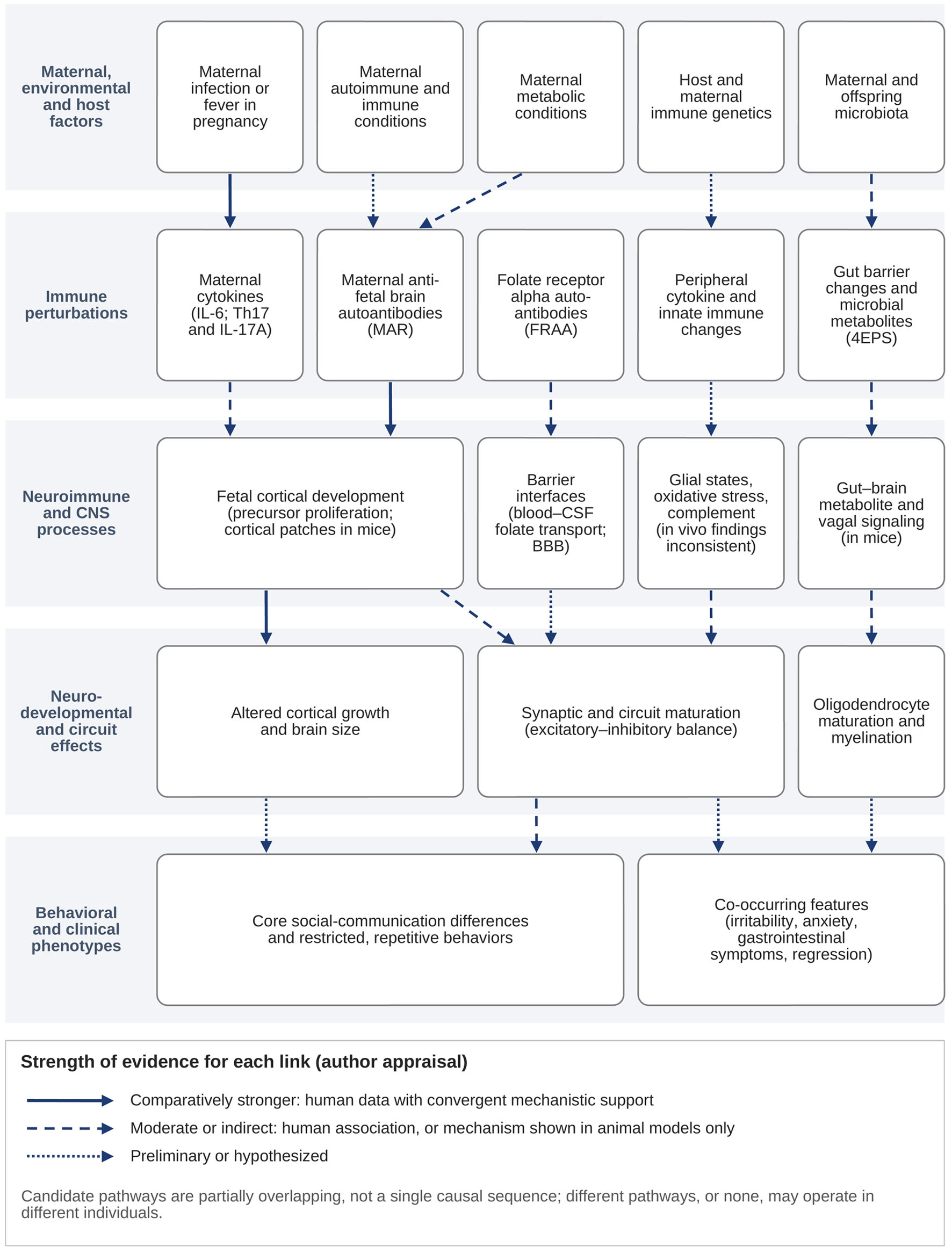
Figure

Tables
| Evidence class | Representative studies | Principal strength | Principal limitation | Causal inference supported |
|---|---|---|---|---|
| All entries represent the author’s appraisal rather than findings reported in the cited studies. | ||||
| Postmortem neuropathology | [1–4, 41, 42, 44] | Direct CNS tissue evidence | Small samples; agonal and medication confounds; late-stage sampling | Presence of a process; not its timing or cause |
| Bulk tissue transcriptomics | [13–15, 33] | Unbiased, genome-wide | Tissue-level, not cell-type resolved; cannot distinguish cause from response | Tissue-level association |
| Single-cell and single-nucleus genomics | [12] | Cell-type-resolved | Few donors; postmortem; cannot distinguish cause from response | Cellular localization of the signal |
| In vivo TSPO-PET | [45–48] | Living brain; repeatable | TSPO not cell-specific; small samples; differing radioligands and quantification; directionally heterogeneous | Altered TSPO signal; not its cellular source or cause |
| Peripheral biomarker studies | [23–26, 38, 62–64] | Scalable; accessible | Correspondence with CNS not established; assay heterogeneity; frequent high risk of bias | Association only |
| CSF studies | [1, 65–67] | Proximal to CNS | Small samples; invasive; matched controls often absent; few paired serum–CSF designs | Association; within-person compartment comparison |
| Epidemiological cohorts | [28–31, 68–71] | Population scale; temporal ordering | Residual confounding not excluded by design | Risk association; exposure timing |
| Rodent MIA and autoantibody models | [17–19, 49, 72–75, 81] | Experimental control; mechanism | Construct validity limits; species differences | Sufficiency of a pathway in the model |
| Non-human primate models | [76–78] | Neurodevelopmental proximity | Very small samples; cost | Translational plausibility |
| Randomized controlled trials | [22, 111, 116, 118, 119, 121, 122, 124, 127] | Controlled test of intervention effects | Many studies are small, short, or adjunctive; behavioral endpoints predominate | Intervention effect if adequately powered; mechanism requires demonstrated target engagement |
| Finding | Modality | Direction | Regions | Limitation/author appraisal |
|---|---|---|---|---|
| Interpretive columns represent the author’s appraisal rather than findings reported by the cited studies (see Section “Review Approach and Evidence Appraisal”). | ||||
| Astroglial and microglial reactivity; elevated MCP-1, TGF-β1; no lymphocytic infiltrate [1] | Postmortem + CSF | ↑ | Cerebellum, ACC, midfrontal | Innate, not adaptive; n small |
| Increased microglial density; activated morphology [2] | Postmortem | ↑ | DLPFC, esp. white matter | Region-specific |
| Abnormal microglia–neuron spatial organization [3] | Postmortem | Altered | DLPFC | Spatial relationship rather than cell number |
| Increased microglial density [41] | Postmortem | ↑ | Fronto-insular and visual cortex | Regions differ from DLPFC studies |
| Elevated GFAP [42] | Postmortem | ↑ | Frontal, parietal, cerebellar | Marker-dependent |
| Region-dependent glial marker expression [4] | Postmortem (transcript) | ↑/mixed | PFC (astrocytic and microglial ↑); cerebellum (astrocytic ↑ only) | Partial discordance; transcript level |
| NF-κB p65 upregulation in neurons and glia [43] | Postmortem | ↑ | Orbitofrontal cortex | Most pronounced in microglia; n = 9 per group |
| Higher [11C]-(R)-PK11195 binding [45] | PET, in vivo | ↑ | Multiple; cerebellar predominance | Men; first-generation ligand |
| Lower [11C]PBR28 signal [46] | PET, in vivo | ↓ | Multiple cortical and subcortical regions | Men; relative uptake measure |
| No overall difference in [18F]FEPPA binding [47] | PET, in vivo | No difference (↓ post hoc) | Prefrontal, temporal, cerebellar, anterior cingulate | Mixed sex; post hoc exclusion |
| Higher [11C]PBR28 signal in women [48] | PET, in vivo | ↑ (regional) | Midcingulate cortex; splenium | Women; pilot sample |
| Immune-glial module upregulation [13–15] | Bulk transcriptomics | ↑ | Cortex | Tissue-level; cannot separate cause/response |
| Cell-type-specific glial signatures [12] | Single-cell genomics | ↑ | Cortex | Supports cellular localization |
| Mediator | Peripheral direction | Consistency | Central or tissue-level evidence | Author appraisal |
|---|---|---|---|---|
| Interpretive columns represent the author’s appraisal rather than findings reported by the cited studies (see Section “Review Approach and Evidence Appraisal”). Cross-diagnostic group differences do not constitute validated individual-level diagnostic accuracy. | ||||
| IL-1β | ↑ | Replicated across meta-analyses [23, 24, 26] | Not established | Strongest pooled peripheral signal; non-specific innate marker |
| IL-6 | ↑ | Replicated [23, 24, 26]; attenuated after excluding high risk-of-bias studies [24] | Frontal cortex tissue [44] | Central in murine MIA [49] |
| IL-8/CXCL8 | ↑ | Replicated [23, 24, 26] | Frontal cortex tissue [44]; ↑ CSF in one adult study [67] | Non-specific |
| MCP-1/CCL2 | ↑ [23]; not significant in largest pooling [24] | Inconsistent; very large heterogeneity [24] | ↑ brain and CSF [1]; ↓ CSF in adults [67] | Directionally inconsistent across compartments |
| TNF-α | ↑ [24]; not ↑ in earlier pooling [23] | Sensitive to study quality [24] | Frontal cortex tissue [44] | Higher in ASD than ADHD [26] |
| IL-2 | Not consistently ↑ versus controls | Higher in ASD than ADHD [26] | None | Cross-diagnostic contrast only |
| IL-17A | ↑ in subgroups [57] and one cohort [62] | Not significant on pooling [24] | ↓ IL-17 mRNA in frontal cortex [89] | Central in murine MIA [18]; human support weak |
| IL-23 | ↓ [55]; no difference [24, 62] | Low | ↓ IL-23 mRNA in frontal cortex [89] | Not aligned with the murine IL-17A axis |
| IFN-γ | ↑ | Replicated [23, 24, 62] | Frontal cortex tissue [44] | Co-elevated with Th2- and Th17-associated mediators [62] |
| IL-4/IL-10 | IL-4 ↑ [24, 26, 62]; IL-10 ↓ [25], ↑ [62], no difference [24] | Inconsistent | None | Direction varies by synthesis |
| IL-34/CSF-1 | ↑ [62] | Single cohort | None; measured in serum only | Not evidence of microglial activation |
| TGF-β1 | ↓ [23]; no difference [24, 25, 62] | Low | ↑ in brain tissue [1] | Earlier pooled reduction not reproduced |
| CXCL1/MIF | ↑ [24] | Few studies; not robust to quality restriction [24] | None | Requires replication |
| IL-1RA | ↓ [25]; ↑ only in quality-restricted analysis [24] | Inconsistent | None | Direction depends on study selection |
| Level | Key findings (reference) | Strength (author appraisal) | Unresolved issue (author appraisal) |
|---|---|---|---|
| Interpretive columns represent the author’s appraisal rather than findings reported by the cited studies (see Section “Review Approach and Evidence Appraisal”). | |||
| Human registry [68, 69] | Infection hospitalization associated with ASD; non-specific across pathogens/trimesters | Population scale; temporal ordering | Modest effect; residual confounding not excluded by these designs |
| Human prospective [70] | Prenatal fever, dose-dependent, second-trimester predominance | Proxy for cytokine response, not pathogen | Fever ascertainment; antipyretic confounding |
| Human negative [71] | No robust influenza infection or vaccination association | Large, well-adjusted; reduces specificity claims | Does not exclude non-influenza inflammation |
| Rodent mechanism [49, 72–74] | IL-6 necessary and sufficient in the model; fetal brain transcriptional response; persistent offspring immune change | Experimental causality within the model | Experimental stimulus and fixed gestational timing limit construct validity |
| Rodent pathway [18, 19, 75] | Maternal Th17/IL-17A required; microbiota-dependent; reversible via S1DZ circuit | Most fully specified experimental pathway reviewed here | Not demonstrated in humans |
| Non-human primate [76–78] | Behavioral, brain growth, cognitive and immune alterations | Closest neurodevelopmental proximity of the models reviewed | Very small samples; fixed-timepoint exposure |
| Finding | Human evidence (reference) | Animal corroboration | Phenotypic anchor | Maturity (author appraisal) |
|---|---|---|---|---|
| Interpretive columns represent the author’s appraisal rather than findings reported by the cited studies (see Section “Review Approach and Evidence Appraisal”). | ||||
| MAR autoantibodies to fetal brain proteins [16, 79] | Defined antigens; reported specificity; risk-assessment estimates | Fetal intraventricular IgG injection [81]; endogenous-antigen model [17] | Abnormal brain enlargement [80] | Comparatively well-characterized candidate subgroup; human causality not established |
| Folate receptor alpha autoantibodies (FRAAs) [87, 88] | Substantial prevalence reported in studied samples; assay characteristics described [88] | Not applicable (proposed mechanism is transport blockade) | Proposed impairment of cerebral folate transport | Moderate; therapeutically testable |
| Child brain-reactive antibodies [83, 84] | Detected; heterogeneous targets | None | None established | Low |
| Anti-neural antigen antibodies with mimicry claims [85, 86] | Immunoassay cross-reactivity | None | None established | Low—methodologically fragile |
| Tier | Representative evidence (reference) | Establishes | Does not establish (author appraisal) |
|---|---|---|---|
| Interpretive columns represent the author’s appraisal rather than findings reported by the cited studies (see Section “Review Approach and Evidence Appraisal”). | |||
| Human descriptive [93–101] | Compositional and metabolomic differences; mucosal immune correlates | Association | Causal direction; diet and medication confounding |
| Barrier markers [91, 92] | Mixed brain tight-junction expression; intestinal tight-junction changes; elevated zonulin | Molecular plausibility | Functional BBB permeability; intestinal markers do not index the BBB |
| Rodent mechanism [21, 102–104] | Metabolite-driven behavioral and oligodendroglial effects | Sufficiency of specific metabolites | Human relevance of concentrations achieved |
| Rodent reconstitution [105, 106] | Single-species rescue via vagal–oxytocin pathway | A manipulable pathway in the experimental models | Applicability to idiopathic human ASD |
| Human-to-germ-free transfer [20] | Donor-dependent behavioral and metabolic phenotypes | Donor-dependent phenotypes in germ-free mice | That it operates in human development |
| Uncontrolled human studies [107, 108] | Symptom improvement reported | Association within an uncontrolled design | Effect distinguishable from expectancy or developmental change |
| Controlled trials [22, 109, 111] | Oral FMT RCT [22]; small double-blind, placebo-controlled probiotic–prebiotic study [109]; kefir-derived probiotic RCT [111] | Controlled estimates of intervention effects | Consistent clinical benefit or microbiome mediation; the FMT trial is limited by sample size and possible functional unblinding [22], and the probiotic RCT showed no between-group clinical effect [111] |
| Systematic review [110] | Evidence base judged small and low quality | Basis for current caution | Nothing further; no pooled effect estimate |
| Candidate | Compartment | Consistency (author appraisal) | CNS anchor | Standing (author appraisal) |
|---|---|---|---|---|
| Interpretive columns represent the author’s appraisal rather than findings reported by the cited studies (see Section “Review Approach and Evidence Appraisal”). | ||||
| MAR autoantibody panel [16, 79] | Maternal serum | High specificity reported [16] | Brain enlargement [80]; animal model [17, 81] | Candidate risk or subtype marker; prospective validation required |
| Folate receptor α autoantibodies (FRAAs) [87, 88] | Serum | Substantial prevalence reported in studied samples [87, 128] | Proposed interference with choroid plexus folate transport [87, 88] | Candidate predictive marker for folinic acid response; not prospectively validated [127, 128] |
| Redox markers (GSH, damage markers) [113, 114] | Blood | Among the more consistently reported pooled peripheral findings reviewed here | Tissue-level findings [112] | No paired peripheral–central validation; one brain-spectroscopy study found no group difference [115] |
| Pro-inflammatory cytokine panels [23, 26, 38] | Plasma/serum | Small–moderate pooled differences; quality-sensitive [24] | Low serum–CSF correspondence within ASD [65] | Not diagnostic; stratification role unvalidated |
| TGF-β1 [23, 25] | Plasma | ↓ in early pooling [23] only | Opposite direction reported in brain tissue [1] | Not reproduced in later pooling [24, 25] |
| Immune endophenotypes [39] | Stimulated PBMC | Subgroup clustering reported in one study [39] | None | Potential stratification approach; not diagnostic |
| Myeloid dendritic cells [59] | Blood | Single cohort | Amygdala volume correlation | Hypothesis-generating |
| Serum zonulin [92] | Serum | Single cohort | Intestinal, not cerebrovascular | Limited; indirect proxy |
| CSF immune mediators [1, 65–67] | CSF | Directionally inconsistent; few controlled studies [66] | Direct | Not a validated marker; controlled paired serum–CSF data needed |
| Intervention | Design | Outcome (reference) | Mechanistic confirmation | Author appraisal |
|---|---|---|---|---|
| Interpretive columns represent the author’s appraisal rather than findings reported by the cited studies (see Section “Review Approach and Evidence Appraisal”). | ||||
| Celecoxib adjunct [121] | RCT, adjunctive, single center | Improved irritability, lethargy, stereotypy | Not assessed | Adjunctive design; effect cannot be attributed to anti-inflammatory action |
| Pentoxifylline adjunct [122] | RCT, adjunctive | Improvement across ABC subscales | Not assessed | Same limitation; overlapping methodology |
| Prednisolone adjunct, regressive ASD [124] | RCT, adjunctive | Behavioral improvement | Not assessed | Candidate subgroup; mechanism not confirmed |
| Minocycline [123] | Open-label pilot | No clinical improvement | Peripheral and CSF biomarker changes only; central target engagement not measured | Biomarker change without detectable clinical improvement |
| IVIG [125, 126] | Open-label pilot; systematic review and meta-analysis | Improvement reported; few controlled studies [126] | Not assessed | Not established outside immunological indications or clinical trials |
| N-acetylcysteine [116, 117] | RCTs; meta-analysis | Pooled improvement in irritability, hyperactivity, and social awareness (2–4 small trials per outcome) [117] | Not assessed | Short, small trials; larger replication needed |
| Sulforaphane [118, 119] | Two RCTs | Improvement; reversal on withdrawal | Proposed Nrf2-related mechanism; target engagement not measured | Positive trials; engagement unmeasured; replication needed |
| Folinic acid, FRAA-associated [127, 128] | RCT with biomarker-associated analysis (not stratified randomization) | Improved verbal communication; larger response reported in FRAA-positive participants | Transport mechanism not directly measured | Preliminary; prospective biomarker-stratified trial needed |
| Microbiota-directed interventions [22, 107–111] | Open-label; double-blind placebo-controlled; RCTs | Improvement in uncontrolled studies; selected differences in one FMT RCT [22]; none in one probiotic RCT [111] | Not assessed | Mixed controlled results; microbiome mediation not shown |
| Candidate subgroup or mechanism | Human evidence and replication | Mechanistic evidence | Biomarker | Phenotype and therapeutic relevance | Current status (author appraisal) |
|---|---|---|---|---|---|
| Status categories represent the author’s appraisal (Section “Review Approach and Evidence Appraisal”), ordered from comparatively well characterized to hypothesized. No candidate meets all criteria for an independently replicated, biologically defined subgroup. FRAA: folate receptor alpha autoantibody; IgG: immunoglobulin G; PBMC: peripheral blood mononuclear cell; PET: positron emission tomography; TSPO: translocator protein. | |||||
| Maternal autoantibody-related ASD | Defined antigen patterns in mothers; high case–control specificity; data largely from one research program [16, 79, 82] | Fetal intraventricular IgG and endogenous-antigen mouse models [17, 81] | Maternal serum antigen panel [16] | Brain enlargement in a subgroup [80]; no targeted therapy | Comparatively well-characterized candidate; independent replication and human causal evidence lacking |
| FRAA-positive | Reported in a substantial proportion of studied samples; assay-dependent [87, 88, 128] | Proposed blockade of choroid plexus folate transport; not directly measured [87] | Serum blocking/binding FRAAs [88] | Larger folinic acid response in biomarker-associated analysis [127] | Replicated association, incomplete biological definition; predictive value untested prospectively |
| Stimulation-defined immune endophenotypes | Cytokine-response clusters in one cohort [39] | Not established | Stimulated PBMC cytokine profile | Behavioral correlates reported in the same cohort [39]; no therapy tested | Exploratory; requires replication |
| Regression with elevated cytokines | Plasma cytokines associated with regression [38, 54] | Not established | Plasma cytokines | Prednisolone adjunct improved behavior [124]; minocycline showed no benefit [123] | Partially supported stratification; mechanism unconfirmed |
| Gastrointestinal symptoms with mucosal immune signatures | Mucosal and peripheral immune differences in ASD with gastrointestinal symptoms [100, 101] | Barrier and microbiota mechanisms in animal models [102] | Mucosal profiles; serum zonulin [92] | Symptom-specific associations [100]; microbiota trials not stratified [22, 111] | Partially supported; ASD-specific definition lacking |
| Maternal infection or fever exposure | Modest, non-specific registry and cohort associations [68–70] | Rodent and primate MIA models [49, 76–78] | Exposure history; no validated biomarker | Not established | Mechanistically plausible; not a definable subgroup in humans |
| Maternal IL-17A axis | Not demonstrated; human IL-17 data inconsistent [24, 55, 57] | Defined murine pathway [18, 19, 75] | None validated | None | Hypothesis derived from animal models |
| Complement-related synaptic alteration | Mixed brain mRNA and plasma protein findings [89, 90] | Developmental pruning biology [50–52] | None | Direction of any effect unknown | Exploratory; direction unresolved |
| Altered TSPO signal | Small, directionally heterogeneous PET studies [45–48] | Signal not cell-type specific | TSPO-PET | Possible sex difference [46, 48] | Insufficiently validated |
| Mechanism | Strongest support (reference) | Principal gap or discordant finding (reference) | Current status (author appraisal) |
|---|---|---|---|
| Interpretive columns represent the author’s appraisal rather than findings reported by the cited studies (Section “Review Approach and Evidence Appraisal”). | |||
| Altered microglial and astroglial states | Postmortem [1–3, 41, 42]; bulk and single-cell transcriptomic [12–15] | Region-dependent marker findings [4]; directionally heterogeneous TSPO-PET [45–48] | Consistently reported at tissue level; in vivo status unresolved |
| MIA via IL-6 and IL-17A | Rodent pathway sufficiency [18, 19, 49, 75]; primate [76–78] | Pathway not demonstrated in humans; modest epidemiological associations [68–71] | Experimentally well specified; limited human anchoring |
| Maternal brain-reactive autoantibodies | Antigen definition [79]; reported specificity [16]; animal models [17, 81]; brain enlargement [80] | Applies to a subgroup; human causality not established | Comparatively well-characterized candidate subgroup |
| Complement-mediated over-pruning | Developmental biology [50–52] | Reduced C3 with adverse behavioral effect in rodents [89]; mixed proteomic findings [90] | Direction unresolved on the evidence reviewed here |
| Barrier dysfunction | Mixed brain tight-junction and MMP-9 findings [91]; intestinal markers [91, 92] | Unreplicated; no functional BBB measurement; low serum–CSF correspondence [65] | Among the least well-established components reviewed here |
| Microbiota-immune-brain signaling | Metabolite mechanisms [21, 102, 103]; reconstitution [105, 106]; transfer [20]; controlled clinical trials [22, 111] | Human descriptive studies not designed to exclude dietary and medication confounding [93–100] | Experimentally supported; controlled clinical findings remain mixed and preliminary |
| Oxidative stress and redox dysregulation | Tissue [112]; large meta-analyses [113, 114]; NF-κB findings [43] | No group difference in in vivo glutathione [115]; no paired peripheral–central design; no direct bioenergetic data | Among the more consistent peripheral findings reviewed here; central status unclear |
| Immune-genetic liability | HLA and rare variant signals [34–37] | Immune modules not genetically enriched [15] | Possible modifying role |