Journal of Neurology Research, ISSN 1923-2845 print, 1923-2853 online, Open Access
Article copyright, the authors; Journal compilation copyright, J Neurol Res and Elmer Press Inc
Journal website https://jnr.elmerpub.com

Review

Volume 16, Number 4, December 2026, pages 238-249


Cardiac Emotional Memory: How Childhood Trauma May Contribute to Atrial Fibrillation and Youth Stroke Risk—A Neurocardiological Framework for Prevention

Figures

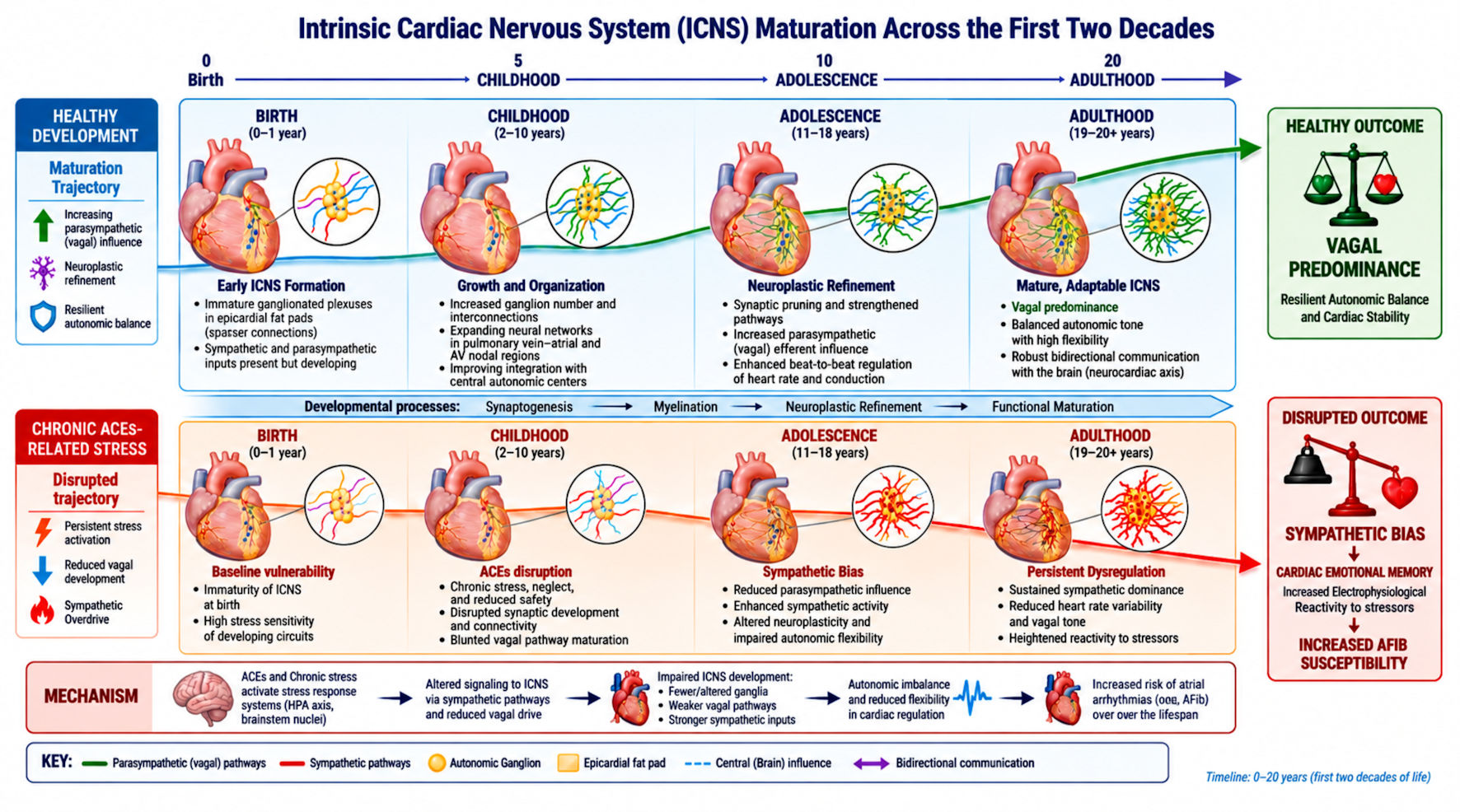
↓  Figure 1. ICNS maturation across the first two decades of life. Upper panel (healthy development): Progressive maturation of the ICNS from immature ganglionated plexuses at birth through neuroplastic refinement in adolescence to mature vagal predominance and adaptable autonomic balance in adulthood. Lower panel (chronic ACEs-related stress): Disrupted ICNS maturation trajectory under persistent stress activation, resulting in sympathetic bias, impaired neuroplasticity, and persistent autonomic dysregulation. Bottom bar: Proposed mechanistic pathway from ACEs-related chronic stress through HPA and sympatho-adrenomedullary activation to impaired ICNS development, autonomic imbalance, and increased AFib susceptibility. “Cardiac emotional memory” denotes a conceptual framework proposed in this review for trauma-mediated ICNS sensitization (see section “The Developing ICNS: Anatomy, Function and Emotional Memory”). ACEs: adverse childhood experiences; AFib: atrial fibrillation; AV: atrioventricular; HPA: hypothalamic–pituitary–adrenal; ICNS: intrinsic cardiac nervous system.
Figure 1.
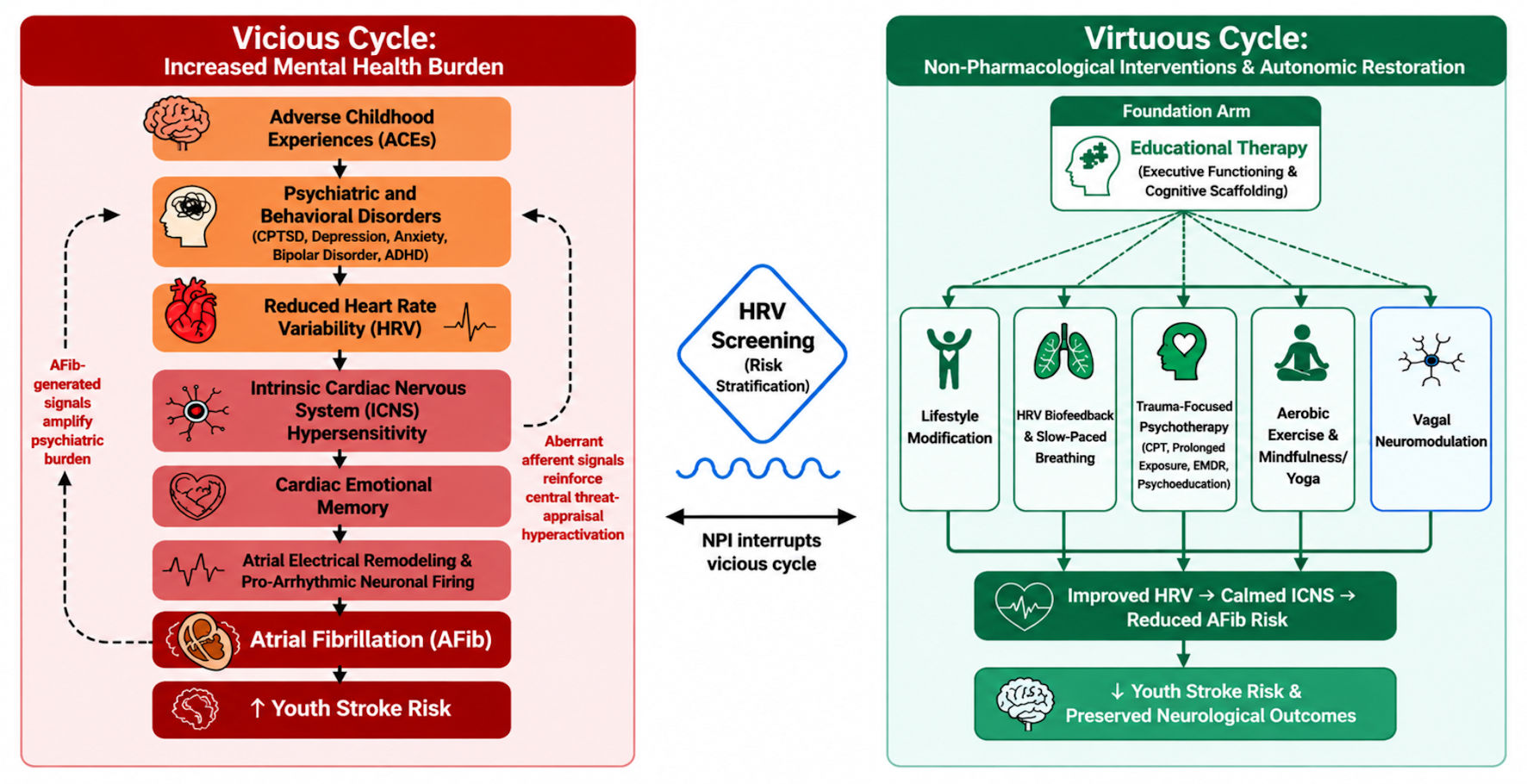
↓  Figure 2. Proposed unified neurocardiological model: from childhood trauma to atrial fibrillation and intervention pathways. Left panel (vicious cycle): Pathophysiological progression from ACEs through psychiatric and behavioral disorders, reduced HRV, ICNS neuronal hypersensitivity, cardiac emotional memory, and atrial electrical remodeling to AFib and increased youth stroke risk, with two self-reinforcing feedback loops. Loop 1, in which aberrant ICNS afferent signals reinforce central threat-appraisal hyperactivation; and Loop 2, in which AFib-generated afferent signals amplify central hyperarousal and psychiatric burden. Center: HRV screening (risk stratification) diamond represents the clinical decision point at which identification of reduced HRV in trauma-exposed children triggers entry into the non-pharmacological intervention framework. Right panel (virtuous cycle): Two-arm non-pharmacological intervention framework showing the educational therapy foundation arm enabling five parallel psychosocial intervention categories, converging on improved HRV, calmed ICNS, reduced AFib risk, and reduced youth stroke risk with preserved neurological outcomes. ACEs: adverse childhood experiences; ADHD: attention-deficit/hyperactivity disorder; AFib: atrial fibrillation; CPT: cognitive processing therapy; CPTSD: complex posttraumatic stress disorder; EMDR: eye movement desensitization and reprocessing; EdTx: educational therapy; HRV: heart rate variability; ICNS: intrinsic cardiac nervous system; niVNS: noninvasive vagus nerve stimulation.
Figure 2.

Tables

↓  Table 1. Estimated ACEs Prevalence Across Global Regions
 
Region≥ 1 ACE (%)≥ 4 ACEs (%)Predominant ACEs categoriesReferences
aWide range reflects substantial between-country variation and methodological heterogeneity across ACE survey instruments used in MENA studies. ACE prevalence figures for LMICs should be interpreted as likely underestimates due to (1) significant under-reporting in contexts with weaker child protection systems; (b) variation across ACE survey instruments—most LMIC studies use the WHO ACE-International Questionnaire (ACE-IQ) rather than the original 10-item Felitti framework; and (c) limited nationally representative data. Figures represent pooled or weighted estimates from the best available regional evidence. ACE: adverse childhood experience; LMIC: low- and middle-income country.
High-income countries (reference)Approximately 64%Approximately 16%Abuse, household dysfunction, neglect[7]
Sub-Saharan AfricaApproximately 72–82%Approximately 20–24%Community and physical violence, orphanhood, sexual violence[8]
South and Southeast AsiaApproximately 70–80%Approximately 25–35%Physical abuse, neglect, child labor, food insecurity[9, 10]
Latin AmericaApproximately 65–75%Approximately 20–30%Community violence, household dysfunction, abuse[7, 11]
Middle East and North AfricaApproximately 50–80%aApproximately 20–30%Conflict, displacement, physical abuse[12]
Eastern Europe and Central AsiaApproximately 65–75%Approximately 18–25%Alcohol-related household dysfunction, physical abuse[13]


↓  Table 2. Risk of Future Atrial Fibrillation and Associated Heart Rate Variability (HRV) Changes in Children and Pediatric With Adverse Childhood Experiences and Psychiatric/Behavioral Disorders
 
ConditionAFib risk (HR/OR)HRV changes in pediatricKey developmental mechanismReferences
aRisk estimate derived from PTSD-diagnosed cohorts; CPTSD-specific longitudinal cardiac data are not yet available. HR: hazard ratio; OR: odds ratio; RMSSD: root mean square of successive differences; HF: high-frequency HRV power; SDNN: standard deviation of NN intervals; LF/HF: low-to-high frequency ratio; ICNS: intrinsic cardiac nervous system; HPA: hypothalamic–pituitary–adrenal; IL-6: interleukin-6; CRP: C-reactive protein; CV: cardiovascular; CPTSD: complex post-traumatic stress disorder.
High ACEs (≥ 4)HR 1.18 (18% increase)Decreased RMSSD; decreased HF power; blunted circadian HRV patternEarly autonomic programming; epigenetic HPA reprogramming; accelerated sympathetic maturation[1, 20]
CPTSD (childhood-onset)HRa 1.13 (13% increase)Decreased RMSSD, SDNN, HF; increased LF/HF ratioHyperarousal + DSO-related emotion dysregulation lead to sustained ICNS neuronal hypersensitivity; disrupted vagal maturation; executive functioning deficits impairing autonomic self-regulation[15, 24, 27]
Depression (pediatric)OR 1.25 (25% increase)Decreased SDNN; decreased RMSSD; blunted nocturnal HRV riseChronic sympathetic dominance during neurodevelopment; increased IL-6, CRP in adolescents[15]
Anxiety (child/adolescent)HR 1.10 (10% increase)Decreased HF-HRV; decreased baroreflex sensitivityHeightened threat-appraisal circuitry leads to persistent vagal withdrawal[15, 28]
Bipolar (early-onset)OR up to 2.0Decreased overall HRV across mood phasesMood instability + neuroinflammation impairing ICNS maturation[15, 52]
ADHDOR range: 1.8–2.0 (CV risk)Decreased resting and task HRV; increased sympathetic reactivityDopaminergic–autonomic dysregulation; potential stimulant-mediated heart rate elevation[16]


↓  Table 3. Effects of Interventions on Heart Rate Variability, Psychiatric Symptoms, and Potential Long-Term Atrial Fibrillation Risk in Trauma-Exposed Children and Youth
 
Therapeutic categoryIntervention and target diagnosisEffect on HRV in pediatricEffect on psychiatric symptomsPotential effect on long-term AFib riskFeasibility in pediatric clinicsReferences
HRV: heart rate variability; RMSSD: root mean square of successive differences; HF: high-frequency HRV power; LF/HF: low-to-high frequency ratio; CPTSD: complex posttraumatic stress disorder; MDD: major depressive disorder; ADHD: attention-deficit/hyperactivity disorder; EMDR: eye movement desensitization and reprocessing; CPT: cognitive processing therapy; PE: prolonged exposure; AFib: atrial fibrillation; ICNS: intrinsic cardiac nervous system; MBSR: mindfulness-based stress reduction; niVNS: noninvasive vagus nerve stimulation; RCT: randomized controlled trial.
PsychotherapyTrauma-focused EMDR, CPT, PE (pediatric-adapted); indicated for CPTSD, MDD, anxietyModest to moderate increase in RMSSDStrong decrease in CPTSD/depression severity (d > 1.0)Indirect benefit via decreasing chronic stress and inflammationHigh: core pediatric clinic service[44–46]
Behavioral therapyHRV biofeedback and slow-paced breathing (about 6 breaths/min; gamified); targets autonomic dysregulation directlyStrong increase in RMSSD and HF powerLarge decrease in anxiety and CPTSD (d range, 0.8–1.5)Promising decrease in autonomic AFib triggers via vagal upregulationVery high: highly engaging for children[47, 48]
Educational therapy (EdTx)Academic and cognitive skill remediation (reading, writing, numeracy); targets learning disabilities (dyslexia, dyscalculia). For CPTSD: targeted executive functioning remediation (working memory, cognitive flexibility, inhibitory control) as NPI for DSO-related neurocognitive deficits. Not a substitute for psychosocial interventionsNo direct HRV effect; may indirectly support autonomic regulation through reduced academic stress and improved self-efficacyReduces behavioral problems and improves self-esteem in children with specific learning disabilities; indirect psychiatric benefitIndirect AFib/stroke risk reduction in CPTSD via reduced cognitive-stress load and support of autonomic self-regulation; complementary to psychosocial NPIs across CPTSD, ADHD, and bipolar disorderVery high: core service in pediatric therapy clinics; often already in place for ADHD and learning disability[49]
PsychoeducationFamily and child psychoeducation on autonomic regulation, sleep hygiene, stress management; first-line for ADHD and bipolar disorder.Indirect increase in HRV via behavior changeIncrease in adherence and self-regulation; decrease in impulsivity and mood dysregulationIndirect protection via lifestyle and medication optimizationVery high: scalable in pediatric clinics[50, 51]
Mind–body/somatic approachesMindfulness (MBSR pediatric-adapted), yoga, pranayama breathing; suits anxiety, CPTSD, and depressionIncrease in HF-HRV; decrease in LF/HF ratioIncrease in emotion regulation; decrease in rumination and hyperarousalModerate indirect benefit via autonomic flexibilityHigh: group or individual delivery[53]
Physical/exercise therapyStructured moderate aerobic exercise programs (pediatric); applicable across all diagnosesIncrease in vagal tone; increase in RMSSDDecrease in depression and anxiety symptom scoresDecrease in systemic inflammation; decrease in atrial remodeling substrate; decrease in AFib burdenHigh: integrates with therapy and school physical education[56]
Lifestyle modificationSleep, dietary quality, screen time reduction, alcohol avoidance; underpins all other interventionsSignificant increase in HRV across all domainsModerate decrease in stress, depression, and anxietyUp to 47% decrease in AFib risk in high-ACE pediatricModerate–high: requires family engagement[1]
Emerging: vagal neuromodulationNoninvasive auricular vagus nerve stimulation (niVNS); adjunct for refractory CPTSD/anxietyPromising increase in HRV; direct vagal activationEmerging benefit for mood and anxiety disordersPotential direct ICNS calming; anti-arrhythmic propertiesModerate: requires specialist equipment[57]