| Journal of Neurology Research, ISSN 1923-2845 print, 1923-2853 online, Open Access |
| Article copyright, the authors; Journal compilation copyright, J Neurol Res and Elmer Press Inc |
| Journal website https://jnr.elmerpub.com |
Case Report
Volume 16, Number 3, September 2026, pages 186-191

Autologous Hematopoietic Stem Cell Transplantation in Aquaporin-4 Immunoglobulin G–Positive Neuromyelitis Optica Spectrum Disorder After Satralizumab Failure
Lizeth Zertuche-Ortunoa, b  , Jose Renan Perez-Pereza, Christian Perez-Lohmana, Jossiel Orlando Hernandez-Carbajala, Erik Ramiro-Guerreroa, Roberto Cervantes-Uribea, Alberto Gonzalez-Aguilara, Sebastian Gutierrez-Casillasa
aNeurology Department, Hospital Angeles Pedregal, Mexico City, Mexico
bCorresponding Author: Lizeth Zertuche-Ortuno, Neurology Department, Hospital Angeles Pedregal, Mexico City, Mexico
Manuscript submitted May 7, 2026, accepted June 5, 2026, published online August 5, 2026
Short title: aHSCT Induces Remission in Refractory NMOSD
doi: https://doi.org/10.14740/jnr1123
| Abstract | ▴Top |
Neuromyelitis optica spectrum disorder (NMOSD) is a severe autoimmune astrocytopathy mediated by aquaporin-4 immunoglobulin G (AQP4-IgG), characterized by recurrent inflammatory events affecting predominantly the optic nerves and spinal cord. Despite the availability of targeted therapies, including monoclonal antibodies such as satralizumab, a subset of patients develops treatment-refractory disease, representing a major therapeutic challenge. We report the case of a 32-year-old woman with a history of hypothyroidism, systemic lupus erythematosus, and antiphospholipid syndrome presenting with AQP4-IgG–positive NMOSD, who experienced disease activity despite treatment with satralizumab. Following relapses with optic neuritis and cervical myelitis, and in the context of limited access to alternative therapies, the patient underwent autologous hematopoietic stem cell transplantation (aHSCT). Conditioning consisted of cyclophosphamide, rituximab, and anti-thymocyte globulin, followed by infusion of 3.11 × 10⁶ CD34+ cells/kg. Early post-transplant complications included neutropenia and pneumonia, both of which were resolved with appropriate treatment. At 2-year follow-up, the patient remains relapse-free with significant functional recovery, despite persistent AQP4-IgG seropositivity. This case supports the role of aHSCT as a rescue therapeutic strategy in highly refractory NMOSD and highlights the dissociation between serological persistence and clinical remission. Long-term follow-up and further studies are required to define the durability of response and optimal patient selection.
Keywords: Stem cell transplant; Neuromyelitis optica; Neuroimmunology; Treatment failure
| Introduction | ▴Top |
Neuromyelitis optica spectrum disorder (NMOSD) is a severe autoimmune disease that involves inflammation and damage to the central nervous system (CNS), primarily affecting the optic nerves and spinal cord [1]. The diagnostic criteria for NMOSD include six core clinical characteristics involving distinct regions of the CNS: the spinal cord, causing longitudinally extensive transverse myelitis; the optic nerve, causing optic neuritis; the medulla, causing area postrema syndrome; the brainstem, causing brainstem syndromes; and the thalamus/hypothalamus, causing acute diencephalic syndromes [2]. Serologically, in ≥ 80% of cases, NMOSD is associated with pathogenic IgG autoantibodies against aquaporin-4 (AQP4-IgG), the most abundant water channel protein in the central nervous system (CNS) [3]. Persistent activation of the immune-inflammatory cascade leads to progressive astrocyte loss, resulting in impaired trophic support, subsequent demyelination, and irreversible axonal injury [4]. Histopathologically, NMOSD lesions demonstrate vasculocentric deposition of immunoglobulins and complement, with inflammatory infiltrates composed of macrophages, granulocytes, and lymphocytes [5]. Altered B-cell tolerance promotes the expansion of autoreactive clones responsible for AQP4-IgG production, while T-cell–mediated B-cell activation and interleukin (IL)-6–driven Th17 polarization further propagate inflammation through neutrophil recruitment [6–8]. Historically, disease-modifying treatment for NMOSD relied on broad, off-label immunosuppression, including corticosteroids, azathioprine, mycophenolate mofetil, and cyclophosphamide; although often effective, these agents are associated with significant long-term toxicity and variable efficacy [9]. Since 2005, accumulating evidence has supported the use of biologic therapies, particularly rituximab and tocilizumab, with rituximab progressively becoming a preferred option due to its demonstrated efficacy [10]. A major therapeutic shift occurred with the approval of targeted monoclonal antibodies, including eculizumab (2019), satralizumab (2021), inebilizumab (2022), and ravulizumab (2023). These agents act on key pathogenic pathways: satralizumab inhibits the IL-6 receptor; eculizumab and ravulizumab target complement component C5; and inebilizumab induces B-cell depletion via CD19, reflecting a transition toward mechanism-based and precision-targeted therapy in NMOSD [11].
Current treatment guidelines recommend that, in cases of inadequate response to a monoclonal antibody, therapy should be switched to an alternative agent with a different mechanism of action [12]. However, in aggressive cases of NMOSD with failure to multiple treatments, or in countries where access to approved therapies is limited, autologous hematopoietic stem cell transplantation (aHSCT) may be considered a therapeutic option [13].
This approach has been employed with acceptable outcomes across multiple case reports and cohort studies in refractory NMOSD. The European Society for Blood and Marrow Transplantation (EBMT) has endorsed aHSCT for refractory NMOSD; however, the current evidence supporting its use remains constrained by small sample sizes and limited follow-up durations [14].
In this context, reporting well-characterized cases of refractory NMOSD treated with aHSCT is of critical importance, as it contributes to the understanding of real-world therapeutic decision-making, particularly in resource-limited settings. Furthermore, such reports provide valuable insight into clinical outcomes, immunological behavior, and long-term disease control following immune reconstitution strategies, helping to refine patient selection and guide future research in this evolving field.
| Case Report | ▴Top |
A 32-year-old woman with a history of hypothyroidism, systemic lupus erythematosus (SLE), and antiphospholipid syndrome (APS)—previously treated with cyclophosphamide, mycophenolate mofetil, and rituximab for lupus activity, including two episodes of lupus nephritis—presented in May 2022 with 1 week of nausea and hiccups, followed by lower-extremity weakness and a thoracic sensory level. She was diagnosed with thoracic myelitis with documented AQP4-IgG positivity (titer 1:10,000), consistent with NMOSD, and was treated with intravenous methylprednisolone followed by plasma exchange. Given prior exposure to cyclophosphamide and rituximab, treatment with satralizumab was initiated, with a favorable clinical response during the first year. However, in July 2023, she developed bilateral optic neuritis followed by cervical myelitis (Fig. 1), requiring intravenous methylprednisolone and five sessions of plasma exchange. In October 2023, she experienced further motor deterioration, with persistent contrast enhancement of the spinal cord lesion on imaging. In January 2024, satralizumab was discontinued due to treatment failure; at that time, no other approved therapies for NMOSD were available in Mexico, and the aHSCT protocol was initiated. In collaboration with the hematology service, hematopoietic stem cell mobilization and collection were performed, followed by conditioning with cyclophosphamide 2.0 g/m2, rituximab 375 mg/m2, and anti-thymocyte globulin 4.5 mg/kg. She subsequently underwent autologous hematopoietic stem cell transplantation with an infusion of 3.11 × 10⁶ CD34+ cells/kg. Early post-transplant complications included neutropenia and pneumonia on day +5, with favorable clinical response to treatment, allowing discharge on day +16. At 1-year follow-up, she developed a single episode of herpes zoster that responded appropriately to acyclovir, with no other infectious complications reported.
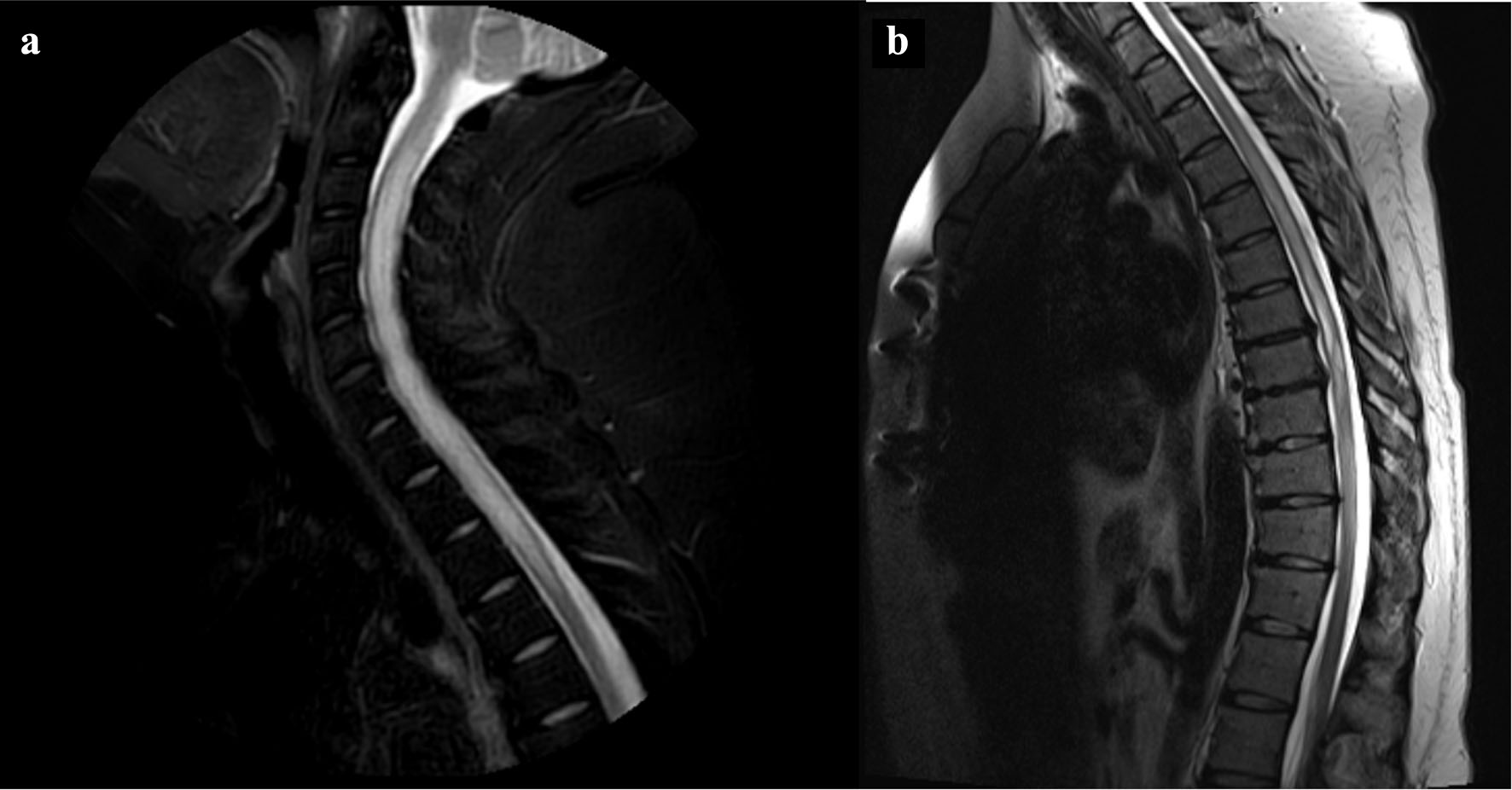 Click for large image | Figure 1. Sagittal spinal MRI demonstrating disease evolution. (a) Extensive cervical myelitis at NMOSD onset. (b) Follow-up MRI performed approximately 18 months later showing a new longitudinally extensive thoracic spinal cord lesion, consistent with ongoing disease activity. |
Regarding her autoimmune comorbidities, the patient has shown no evidence of SLE activity and is currently maintained on hydroxychloroquine as her sole rheumatologic therapy, representing a significant reduction in her previous immunosuppressive treatment burden. Her APS has been managed with warfarin and regular international normalized ratio (INR) monitoring throughout the follow-up period, with no thrombotic events reported to date. Thyroid function has remained stable on a fixed dose of levothyroxine, with no adjustments required during the follow-up period.
During follow-up, AQP4-IgG seropositivity persisted (titers 1:1,000) at both 1- and 2-year post-transplant evaluations, therefore, maintenance therapy with rituximab (1 g every 6 months) was initiated starting 1 year after transplantation. The patient has undergone rehabilitation and has remained free of clinical relapses at 2 years of follow-up, with recovery of ambulation and only mild residual weakness and dyschromatopsia. She continues under close neurological surveillance with ongoing serological monitoring of AQP4-IgG. A graphical summary of the patient’s clinical course and treatment history is presented in Figure 2.
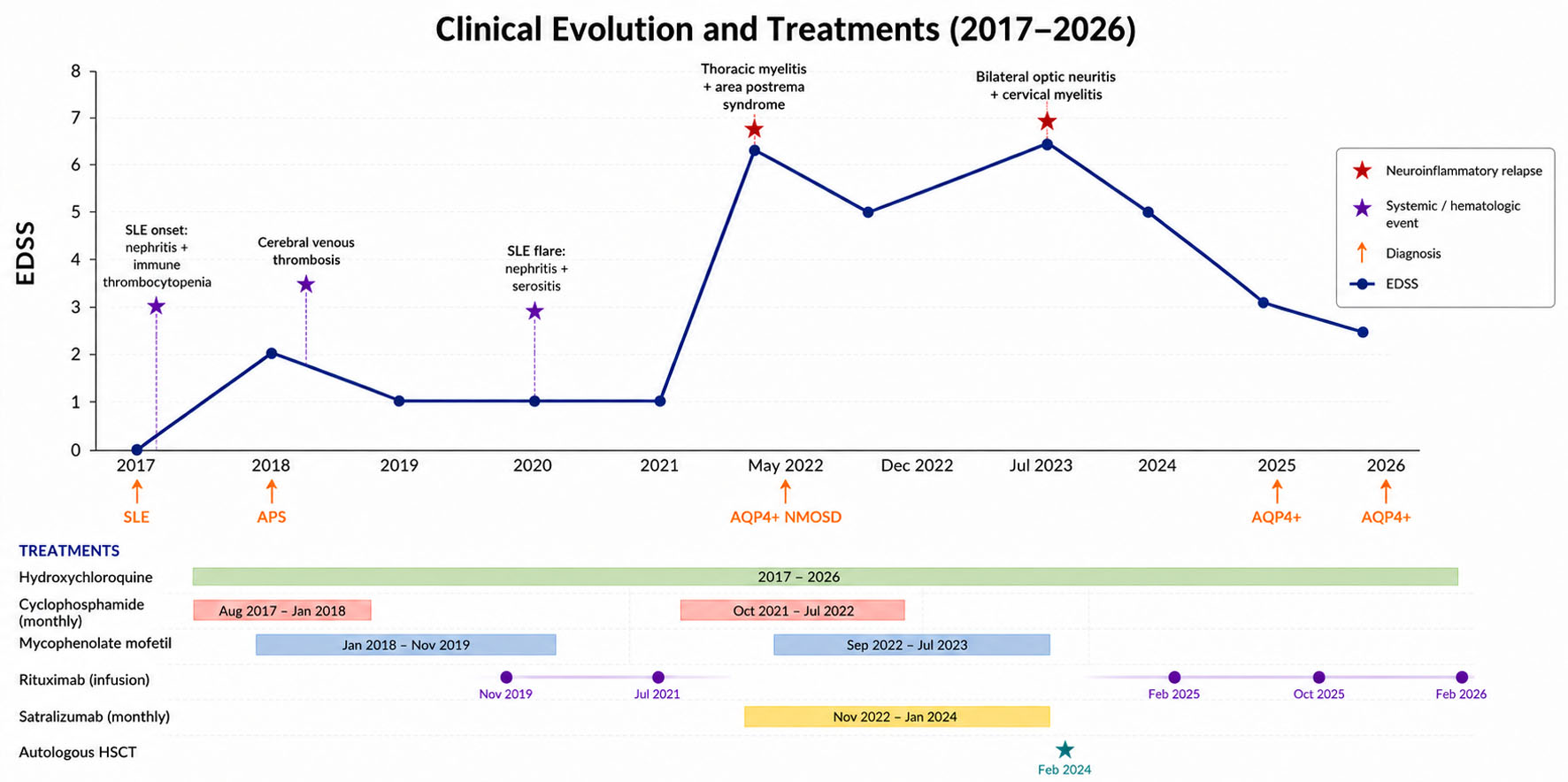 Click for large image | Figure 2. Longitudinal clinical course, key events, and treatment exposure from 2017 to 2026. EDSS: Expanded Disability Status Scale; SLE: systemic lupus erythematosus; APS: antiphospholipid syndrome; NMOSD: neuromyelitis optica spectrum disorder; AQP4: aquaporin-4; AQP4-IgG: aquaporin-4 immunoglobulin G antibody; ITP: immune thrombocytopenia; aHSCT: autologous hematopoietic stem cell transplantation. |
| Discussion | ▴Top |
We present a case of aggressive, treatment-refractory NMOSD in a patient with concomitant autoimmune comorbidities, SLE, and APS, who had previously been treated with rituximab and satralizumab before undergoing aHSCT. At 2 years of follow-up, she has demonstrated a favorable clinical response, although persistent AQP4-IgG seropositivity suggests an ongoing risk of disease reactivation.
Importantly, disease control extended beyond NMOSD. The patient has remained free of clinical or laboratory evidence of SLE activity and is currently maintained on hydroxychloroquine monotherapy, representing a substantial reduction in her prior immunosuppressive burden. Likewise, her APS has remained stable with no thrombotic events observed during follow-up. These findings are noteworthy given the reported efficacy of aHSCT in selected patients with severe refractory SLE, where sustained remission and significant reductions in immunosuppressive requirements have been described. Although the contribution of aHSCT to the long-term control of her coexisting autoimmune diseases cannot be definitively established, the absence of lupus or APS reactivation following transplantation further supports the potential of immune reconstitution strategies to induce durable disease control across multiple autoimmune conditions [15].
AHSCT has emerged as a promising and increasingly recognized therapeutic option for patients with severe, refractory NMOSD [16]. Although the existing evidence is largely derived from case reports [17–19] and a limited number of prospective cohort studies [20, 21], the cumulative results are consistently encouraging and support further investigation of this approach, as shown in Table 1.
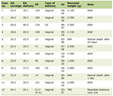 Click to view | Table 1. Summary of Reported Cases of aHSCT in NMOSD |
Several cohorts have demonstrated that long-term disease control is achievable in a subset of patients, with 5-year relapse-free survival rates ranging from 66% to 80% [21]. Similarly, a meta-analysis of nine studies including 39 NMOSD patients treated with aHSCT reported a progression-free survival rate of 69%, further supporting its role as a clinically meaningful therapeutic intervention in refractory disease [22]. Collectively, these findings suggest that aHSCT can effectively suppress disease activity for prolonged periods in selected patients.
However, the durability of remission appears to be strongly influenced by persistent AQP4-IgG seropositivity. Across multiple studies, continued seropositivity following aHSCT was associated with an increased risk of relapse, further supporting the pathogenic role of AQP4-IgG in NMOSD [23, 24]. These findings underscore the importance of long-term clinical and serological monitoring after aHSCT and suggest that reinitiation of immunosuppressive therapy may be warranted in selected patients with persistent seropositivity or evidence of disease reactivation.
These observations support the concept that aHSCT may reset immune function without completely eradicating the autoreactive B-cell and plasma-cell populations responsible for AQP4-IgG production. Very long-term follow-up data indicate that disease recurrence may occur even after prolonged periods of remission, and that immune reconstitution following transplantation may not provide permanent protection against disease reactivation, emphasizing the need for continued long-term monitoring [24].
Importantly, the heterogeneity of study designs, different conditioning regimens, and patient populations limits direct comparability across studies. Questions persist regarding the long-term durability of remission following transplantation, and the procedure’s efficacy relative to emerging alternative therapies has yet to be adequately established. Larger prospective studies with extended follow-up are therefore needed to define the true long-term efficacy and safety profile of aHSCT in this population.
Conclusions
Although clinical evidence remains limited, available data provide consistently encouraging signals regarding the efficacy and safety of aHSCT, supporting its role as a potentially valuable immunotherapeutic strategy in the management of NMOSD, particularly in patients refractory to conventional immunosuppressive therapies. Based on current evidence, aHSCT should be considered a viable therapeutic option in this setting. However, persistent AQP4-IgG seropositivity following transplantation may indicate an ongoing risk of disease reactivation, warranting careful long-term monitoring and consideration when assessing treatment outcomes. Larger multicenter studies with standardized protocols and long-term follow-up are needed to better define the role of aHSCT within the evolving therapeutic landscape of NMOSD.
Acknowledgments
The authors thank the patient for providing written informed consent for the publication of this case.
Financial Disclosure
This research did not receive any specific grant from funding agencies in the public, commercial, or not-for-profit sectors.
Conflict of Interest
The authors declare that they have no conflict of interest related to this work.
Informed Consent
This case report was conducted in accordance with the ethical standards of the institutional and national research committees, informed consent was obtained from all individual participants or their legal representatives. All patient data were anonymized to ensure confidentiality and privacy.
Author Contributions
LZO contributed to the study concept, design, and critical revision of the manuscript. JRPP performed the literature search and contributed to the drafting of the manuscript. CPL contributed to data collection and drafting of the manuscript. JOHC contributed to data collection and clinical follow-up. ERG contributed to data interpretation and critical revision of the manuscript. RCU contributed to data interpretation and supervised the clinical management of the case. AGA contributed to the study design and critical revision of the manuscript. SGC contributed to the study concept, supervision, and final approval of the manuscript. All authors read and approved the final version of the manuscript.
Data Availability
Any inquiries regarding supporting data availability of this study should be directed to the corresponding author.
Abbreviations
aHSCT: autologous hematopoietic stem cell transplantation; APS: antiphospholipid syndrome; AQP4-IgG: aquaporin-4 immunoglobulin G antibody; EDSS: Expanded Disability Status Scale; ITP: immune thrombocytopenia; NMOSD: neuromyelitis optica spectrum disorder; SLE: systemic lupus erythematosus
| References | ▴Top |
- Wingerchuk DM, Lennon VA, Lucchinetti CF, Pittock SJ, Weinshenker BG. The spectrum of neuromyelitis optica. Lancet Neurol. 2007;6(9):805-815.
doi pubmed - Huda S, Whittam D, Bhojak M, Chamberlain J, Noonan C, Jacob A. Neuromyelitis optica spectrum disorders. Clin Med (Lond). 2019;19(2):169-176.
doi pubmed - Jarius S, Wildemann B, Paul F. Neuromyelitis optica: clinical features, immunopathogenesis and treatment. Clin Exp Immunol. 2014;176(2):149-164.
doi pubmed - Jasiak-Zatonska M, Kalinowska-Lyszczarz A, Michalak S, Kozubski W. The immunology of neuromyelitis optica-current knowledge, clinical implications, controversies and future perspectives. Int J Mol Sci. 2016;17(3):273.
doi pubmed - Kinoshita M, Okuno T. Autoimmune-mediated astrocytopathy. Inflamm Regen. 2023;43(1):39.
doi pubmed - Verkman AS, Phuan PW, Asavapanumas N, Tradtrantip L. Biology of AQP4 and anti-AQP4 antibody: therapeutic implications for NMO. Brain Pathol. 2013;23(6):684-695.
doi pubmed - Bennett JL, O'Connor KC, Bar-Or A, Zamvil SS, Hemmer B, Tedder TF, von Budingen HC, et al. B lymphocytes in neuromyelitis optica. Neurol Neuroimmunol Neuroinflamm. 2015;2(3):e104.
doi pubmed - Wang HH, Dai YQ, Qiu W, Lu ZQ, Peng FH, Wang YG, Bao J, et al. Interleukin-17-secreting T cells in neuromyelitis optica and multiple sclerosis during relapse. J Clin Neurosci. 2011;18(10):1313-1317.
doi pubmed - Demuth S, Collongues N. Disease-modifying treatments for neuromyelitis optica spectrum disorder in the context of a new generation of biotherapies. Rev Neurol (Paris). 2025;181(1-2):42-51.
doi pubmed - Shi Y, Li Y, Xu X, Liu J, An X, Zhang M, Shen Y, et al. A real-world comparative study on the efficacy and safety of tocilizumab and rituximab in patients with neuromyelitis optica spectrum disease and myelin oligodendrocyte glycoprotein antibody-associated disease. Mult Scler Relat Disord. 2026;105:106871.
doi pubmed - Pittock SJ, Zekeridou A, Weinshenker BG. Hope for patients with neuromyelitis optica spectrum disorders - from mechanisms to trials. Nat Rev Neurol. 2021;17(12):759-773.
doi pubmed - Kumpfel T, Giglhuber K, Aktas O, Ayzenberg I, Bellmann-Strobl J, Haussler V, Havla J, et al. Update on the diagnosis and treatment of neuromyelitis optica spectrum disorders (NMOSD) - revised recommendations of the Neuromyelitis Optica Study Group (NEMOS). Part II: Attack therapy and long-term management. J Neurol. 2024;271(1):141-176.
doi pubmed - Ceglie G, Papetti L, Valeriani M, Merli P. Hematopoietic stem cell transplantation in neuromyelitis optica-spectrum disorders (NMO-SD): State-of-the-Art and future perspectives. Int J Mol Sci. 2020;21(15):5304.
doi pubmed - Muraro PA, Mariottini A, Greco R, Burman J, Iacobaeus E, Inglese M, Snowden JA, et al. Autologous haematopoietic stem cell transplantation for treatment of multiple sclerosis and neuromyelitis optica spectrum disorder - recommendations from ECTRIMS and the EBMT. Nat Rev Neurol. 2025;21(3):140-158.
doi pubmed - Zare Moghaddam M, Mousavi MJ, Ghotloo S. Stem cell-based therapy for systemic lupus erythematous. J Transl Autoimmun. 2024;8:100241.
doi pubmed - Shao B, Chu L. Autologous hematopoietic stem cell transplantation in neuromyelitis optica. J Stem Cell Res Transplant. 2022;9(1):1042.
- Peng F, Qiu W, Li J, Hu X, Huang R, Lin D, Bao J, et al. A preliminary result of treatment of neuromyelitis optica with autologous peripheral hematopoietic stem cell transplantation. Neurologist. 2010;16(6):375-378.
doi pubmed - Hoay KY, Ratnagopal P. Autologous Hematopoietic Stem Cell Transplantation for the Treatment of Neuromyelitis Optica in Singapore. Acta Neurol Taiwan. 2018;27(1):26-32.
pubmed - Carlisle N, Hari P, Brod S. Plegia to walking: AHSCBMT in severe NMOSD relapse. BMJ Neurol Open. 2020;2(2):e000073.
doi pubmed - Greco R, Bondanza A, Oliveira MC, Badoglio M, Burman J, Piehl F, Hagglund H, et al. Autologous hematopoietic stem cell transplantation in neuromyelitis optica: a registry study of the EBMT Autoimmune Diseases Working Party. Mult Scler. 2015;21(2):189-197.
doi pubmed - Burt RK, Balabanov R, Han X, Burns C, Gastala J, Jovanovic B, Helenowski I, et al. Autologous nonmyeloablative hematopoietic stem cell transplantation for neuromyelitis optica. Neurology. 2019;93(18):e1732-e1741.
doi pubmed - Nabizadeh F, Masrouri S, Sharifkazemi H, Azami M, Nikfarjam M, Moghadasi AN. Autologous hematopoietic stem cell transplantation in neuromyelitis optica spectrum disorder: A systematic review and meta-analysis. J Clin Neurosci. 2022;105:37-44.
doi pubmed - Burton JM, Duggan P, Costello F, Metz L, Storek J. A pilot trial of autologous hematopoietic stem cell transplant in neuromyelitis optic spectrum disorder. Mult Scler Relat Disord. 2021;53:102990.
doi pubmed - Vorasoot N, Blackburn KM, Nguyen L, Bush ML, Jenkins SM, Jitprapaikulsan J, Fryer JP, et al. Late Relapse After Autologous Hematopoietic Stem Cell Transplantation in AQP4-IgG-Positive NMOSD. JAMA Netw Open. 2025;8(4):e255989.
doi pubmed
This article is distributed under the terms of the Creative Commons Attribution 4.0 International License (CC BY 4.0), which permits unrestricted use, distribution, and reproduction in any medium, including commercial use, provided the original work is properly cited.
Journal of Neurology Research is published by Elmer Press Inc.