

Symptomatic Improvement in Amyotrophic Lateral Sclerosis During Low-Dose Sublingual Ketamine Treatment for Depression
DOI:
https://doi.org/10.14740/jnr1140Keywords:
Ketamine, Neurodegeneration, NMDA receptor antagonist, Sigma-1 receptor, Amyotrophic lateral sclerosisAbstract
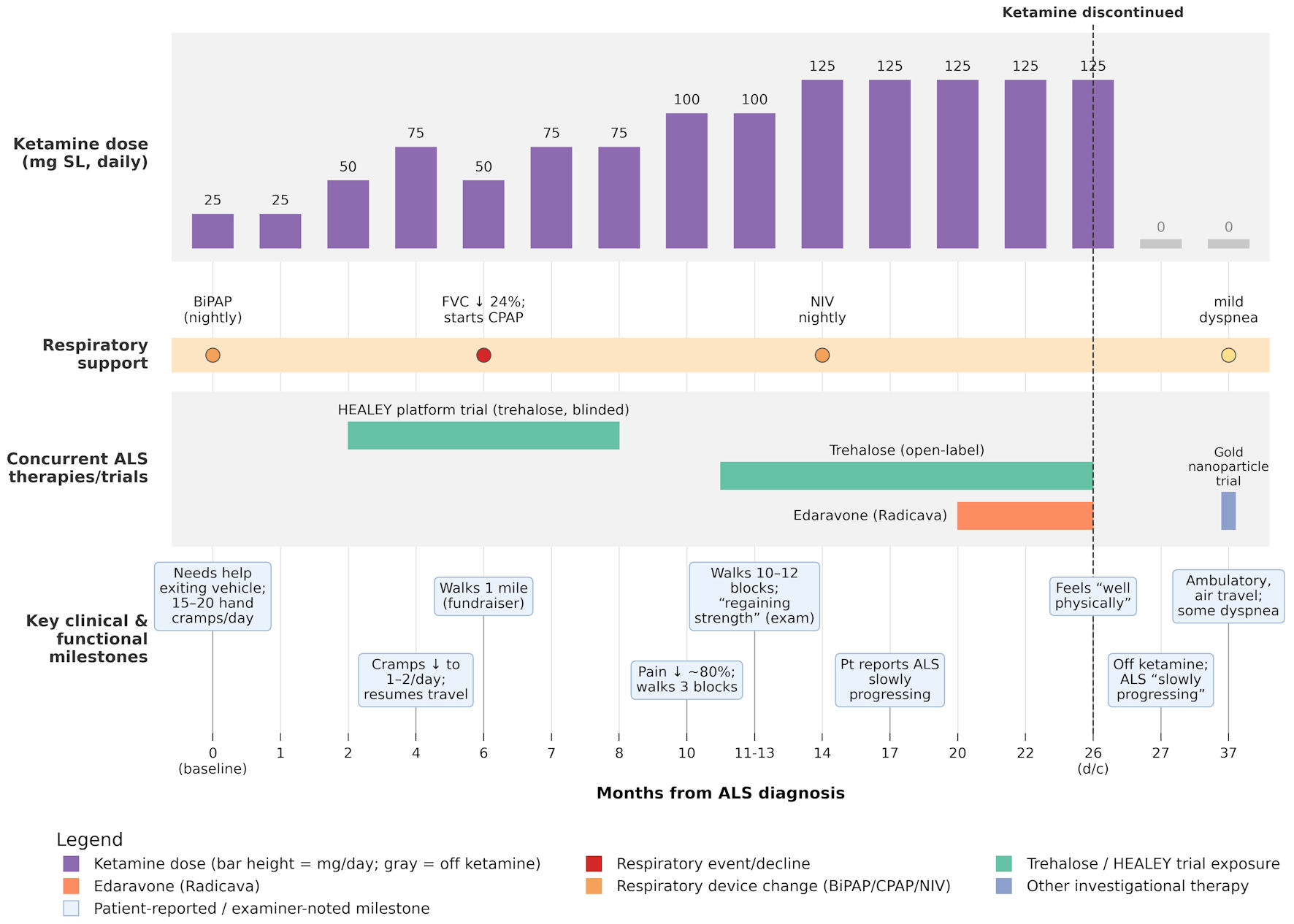
Amyotrophic lateral sclerosis (ALS) is a progressive neurodegenerative disorder with limited treatment options. Ketamine has demonstrated neuroprotective properties in preclinical models through multiple mechanisms, including N-methyl-D-aspartate (NMDA) receptor antagonism and sigma-1 receptor agonism. We present the case of a man with ALS whose symptoms improved during treatment with low-dose sublingual ketamine. To our knowledge, this is the first published case describing clinical improvement in ALS during treatment with low-dose ketamine. The patient was a 64-year-old man with comorbid major depressive disorder (MDD), attention-deficit/hyperactivity disorder (ADHD), and panic disorder who was diagnosed with ALS. Following initiation of low-dose sublingual ketamine (25–125 mg daily) for treatment-resistant depression, the patient exhibited stabilization and improvement of ALS symptoms over a 3-year observation period. Serial clinical examinations and functional assessments showed stabilization and, in some domains, improvement of motor function over more than 2 years of treatment. Muscle cramping frequency decreased from an estimated 15–20 episodes per day at baseline to 1–2 episodes per day by month 4, with complete resolution of lower extremity muscle cramps and an approximately 80% reduction in reported pain intensity. Independent periodic neurologic evaluations over 3 years documented absence of disease progression, and a subsequent examination at month 13 described the patient as “regaining muscle strength,” findings that are atypical in established ALS. Walking distance increased from less than one block, with need for assistance exiting a vehicle, to 10–12 city blocks independently by month 13. The patient also completed a 1-mile ALS charity walk at month 6 while using nocturnal noninvasive ventilation. Following discontinuation of ketamine after approximately 26 months of treatment, the patient experienced mood deterioration while ALS symptoms resumed slow progression. As of 37 months post-diagnosis, the patient remains ambulatory and capable of air travel, a remarkably extended functional period for ALS. This case provides clinical evidence supporting potential disease modifying effects of low-dose sublingual ketamine in ALS, possibly mediated through sigma-1 receptor agonism, NMDA receptor modulation, and anti-inflammatory mechanisms. The extended survival and functional capacity observed suggest therapeutic implications for ALS and potentially other neurodegenerative disorders sharing common pathophysiological pathways.
Published
Issue
Section
License
Copyright (c) 2026 The authors

This work is licensed under a Creative Commons Attribution-NonCommercial 4.0 International License.