

Neuroimmune Mechanisms in Autism Spectrum Disorder: Current Evidence, Pathophysiological Insights, and Therapeutic Implications
DOI:
https://doi.org/10.14740/jnr1142Keywords:
Autism spectrum disorder, Neuroimmunomodulation, Microglia, Cytokines, Complement system proteins, Autoantibodies, Blood–brain barrier, Gastrointestinal microbiomeAbstract
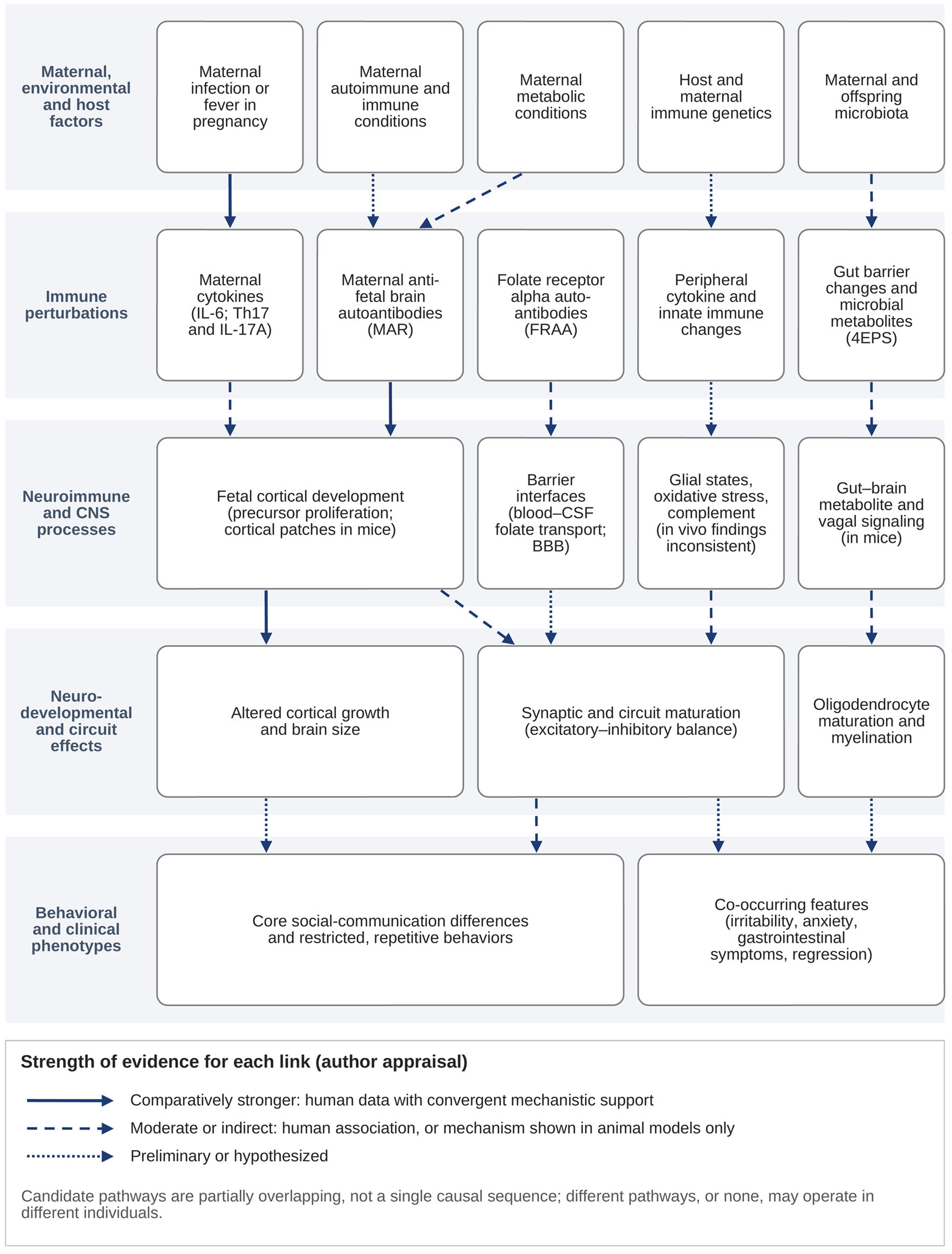
Autism spectrum disorder (ASD) has been linked to immune dysregulation for two decades, but the field has shifted from describing inflammation to asking whether immune processes are causal, consequential, or coincidental in a subset of affected individuals. The objective of the review was to critically synthesize evidence on neuroimmune mechanisms in ASD, reconcile conflicting findings, evaluate methodological quality, and assess the maturity of neuroimmune therapeutic targets. Critical narrative review of literature identified through searches of PubMed/MEDLINE, Scopus, and Web of Science (final search June 30, 2026) and reference screening, integrating postmortem, transcriptomic, imaging, peripheral and cerebrospinal fluid biomarker, epidemiological, animal-model, and clinical-trial evidence. Evidence was weighted by explicit appraisal criteria, including proximity to the central nervous system, species, design, sample size, replication, and mechanistic specificity. Postmortem and transcriptomic studies, including cell-type-resolved genomics, implicate altered microglial and astrocytic states, whereas the few in vivo translocator protein positron emission tomography studies are small and directionally heterogeneous. The largest peripheral cytokine meta-analysis reports small-to-moderate group elevations of several mediators, including tumor necrosis factor-α, with high heterogeneity, frequent high risk of bias, and no consistent association with autism traits. Cerebrospinal fluid studies are more numerous than often assumed but small and rarely controlled, and serum–cerebrospinal fluid correspondence within autistic children was low. Experimental maternal immune activation provides one of the most fully specified causal pathways in animal models, including an interleukin-17A-dependent mechanism, whereas human epidemiological associations are modest and non-specific. Maternal autoantibody-related autism is the comparatively best-characterized candidate neuroimmune subgroup, although its causal role in humans is unestablished. Complement findings are directionally inconsistent, and most immunomodulatory trials are small, short, adjunctive, and reliant on behavioral endpoints. Neuroimmune abnormalities in ASD are biologically heterogeneous and differ in evidentiary strength across mechanistic domains; evidence of heterogeneity does not by itself establish independently replicated, biologically defined subgroups. Peripheral immune measures cannot be assumed to index central neuroinflammation, and pathways demonstrated in animal models await human validation. No broad neuroimmune therapy is established for the core features of ASD. Progress will require biologically informed stratification, central or mechanism-proximal measurement, longitudinal designs, independent replication, and mechanism-matched trials.
Published
Issue
Section
License
Copyright (c) 2026 The authors

This work is licensed under a Creative Commons Attribution 4.0 International License.