


Cardiac Emotional Memory: How Childhood Trauma May Contribute to Atrial Fibrillation and Youth Stroke Risk—A Neurocardiological Framework for Prevention
DOI:
https://doi.org/10.14740/jnr1153Keywords:
Ischemic stroke, Cardiac emotional memory, Adverse childhood experiences, Complex posttraumatic stress disorder, Intrinsic cardiac nervous systemAbstract
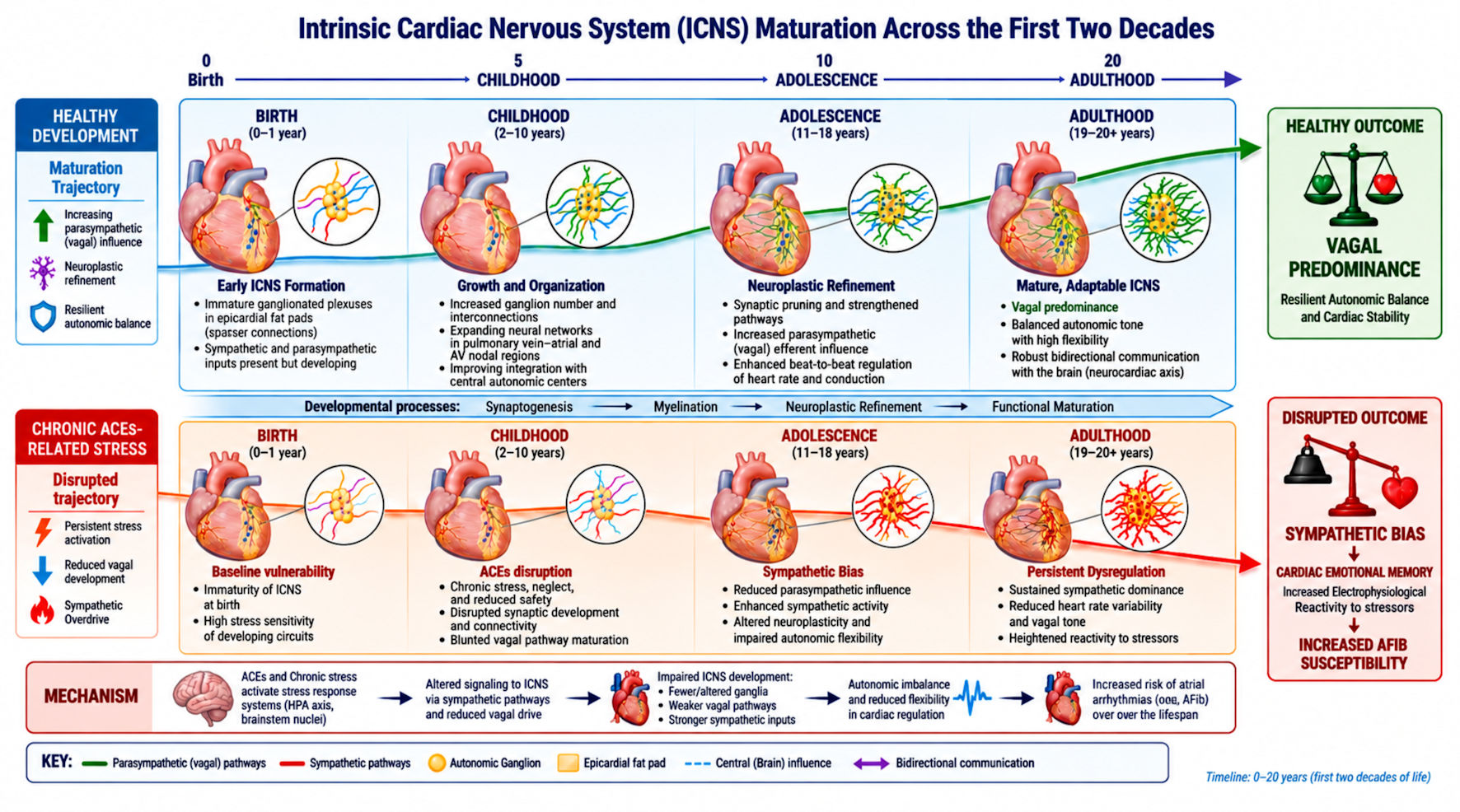
Adverse childhood experiences (ACEs) occur in about 64% of children living in high-income countries and even greater percentages in low- and middle-income countries. However, no information on the cardiac impact of ACEs has been incorporated into the pediatric clinical care paradigm. ACEs lead to permanent changes in the stress response systems, the autonomic nervous system and hypothalamus–pituitary–adrenal axis. The atrial fibrillation (AFib) may increase the risk of ischemic stroke five-fold and is responsible for 20% to 30% of stroke cases worldwide. This narrative review will incorporate the results from epidemiological, neurocardiological, and developmental studies to propose the intrinsic cardiac nervous system (ICNS) and heart rate variability (HRV) as key mechanisms that link early-life trauma to AFib. Individuals exposed to a high burden of ACEs had an 18% increased risk of AFib incidence (hazard ratio (HR) 1.18; 95% CI, 1.05–1.33), and each ACE-linked psychiatric diagnosis significantly reduces HRV and increases arrhythmia risk independently. This association is observational and weaker than that reported for ischemic heart disease. Trauma experienced during critical developmental stages of the ICNS interferes with its proper development, causing a sympathetically biased and AFib-prone nervous system in adolescence or early adulthood. In observational data, a healthy lifestyle was associated with up to 47% lower AFib risk among trauma-exposed adults. This has not been tested in children. Effective non-pharmacological interventions, including psychotherapy, HRV biofeedback, educational therapy, mind–body methods, physical exercise, and vagal neuromodulation, improve both psychiatric status and HRV. A neurocardiological developmental paradigm is presented, where HRV assessment and a combined approach to psychological and cardiac health prevention are important elements of pediatric practice.
Published
Issue
Section
License
Copyright (c) 2026 The authors

This work is licensed under a Creative Commons Attribution 4.0 International License.