


Annual Body Mass Index Change and Mortality in Patients With Amyotrophic Lateral Sclerosis Using Tracheostomy Invasive Ventilation
DOI:
https://doi.org/10.14740/jnr1137Keywords:
Amyotrophic lateral sclerosis, Body mass index, Body weight, Weight gain, Mortality, Tracheostomy, Respiration, Enteral nutritionAbstract
Background: Low body mass index (BMI) and body weight loss have been associated with poor prognosis in amyotrophic lateral sclerosis (ALS). However, the clinical significance of BMI change in patients with ALS using tracheostomy invasive ventilation (TIV) remains unclear. This study examined whether BMI, annual BMI change, and the magnitude of annual BMI change were associated with mortality in patients with ALS using TIV.
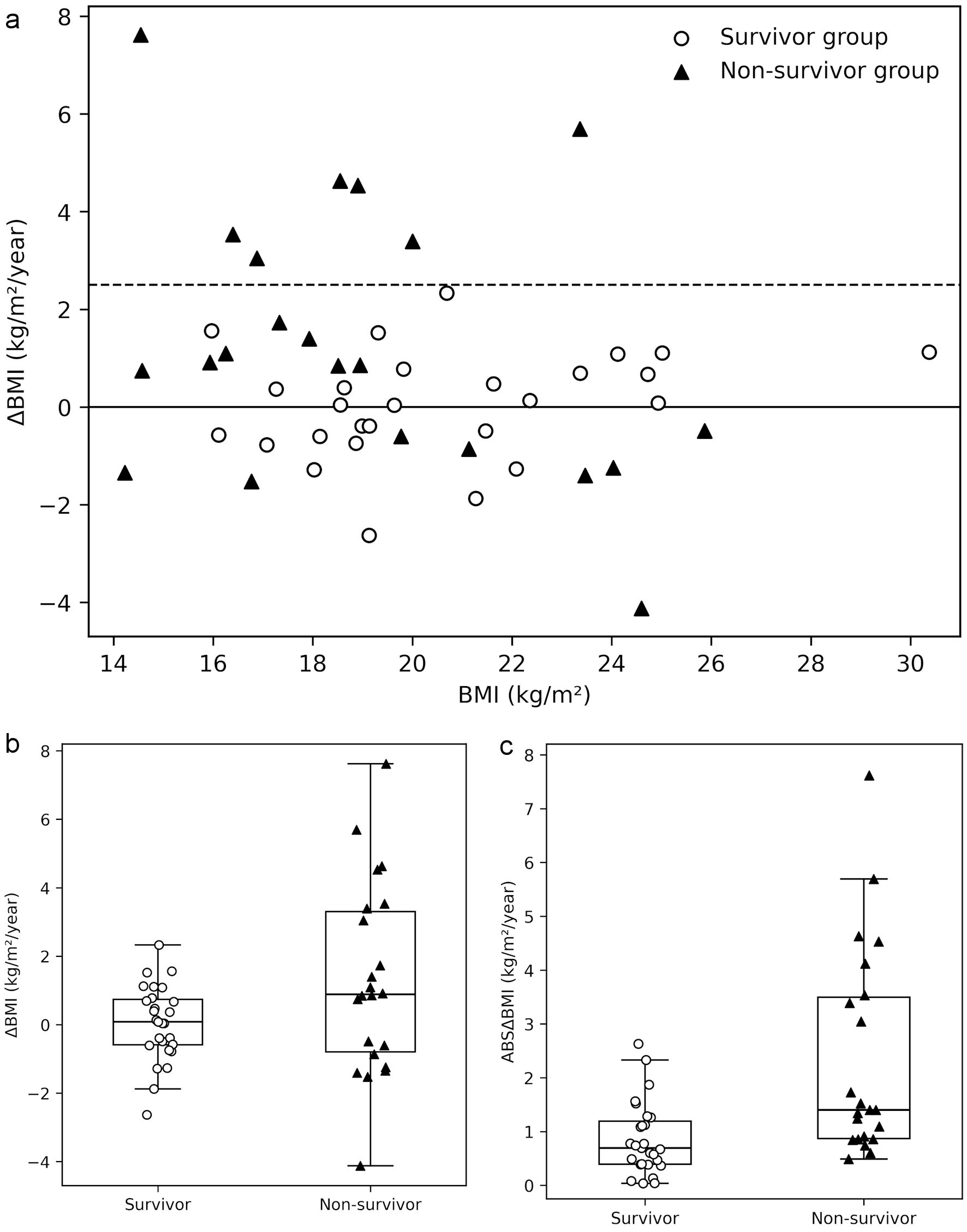
Methods: This single-center retrospective longitudinal observational study screened patients with ALS using TIV who were admitted to Sayama Neurological Hospital between 2010 and 2016. Patients with available height, body weight, BMI measurements approximately 12 months apart, and mortality status were included. Annual BMI change (ΔBMI) was calculated from two BMI measurements, and the absolute value of ΔBMI (ABSΔBMI) was used as an index of the magnitude of annual BMI fluctuation. In the non-survivor group, BMI change during approximately 1 year before death was evaluated. BMI-related measures and clinical characteristics were compared between the survivor and non-survivor groups.
Results: Of 77 candidate patients, 49 were included in the final analysis. Twenty-two patients were classified into the non-survivor group and 27 into the survivor group. BMI and ΔBMI did not differ significantly between the groups. In contrast, ABSΔBMI was significantly greater in the non-survivor group. In an exploratory descriptive analysis, ΔBMI ≥ 2.5 kg/m2/year was observed in seven patients (31.8%) in the non-survivor group and in no patients in the survivor group.
Conclusions: In patients with ALS using TIV, the magnitude of annual BMI fluctuation, particularly marked BMI increase, may be clinically relevant. BMI increase in this population should not be interpreted simply as an improvement in nutritional status but should be considered cautiously as a possible indicator of changes in physical condition.
Published
Issue
Section
License
Copyright (c) 2026 The authors

This work is licensed under a Creative Commons Attribution 4.0 International License.