


Modeling Early Neurologic Trajectories After Elevated Leg Positioning in Acute Moderate Ischemic Stroke: A Secondary Analysis of the LEG-UP Randomized Feasibility Study
DOI:
https://doi.org/10.14740/jnr1146Keywords:
Acute moderate ischemic stroke, Elevated leg positioning, NIHSS, Early neurologic trajectory, Analysis of covariance, Feasibility trial, LEG-UPAbstract
Background: Elevated leg positioning (ELP) is a noninvasive intervention hypothesized to augment venous return and cerebral perfusion in acute ischemic stroke. The association between ELP and early neurologic recovery has not been established, and prior positioning trials have not demonstrated plausible functional benefit. We evaluated the association between randomized assignments to ELP and early neurologic trajectory, assessed using the day-7 National Institutes of Health Stroke Scale (NIHSS) after adjusting for baseline neurologic severity.
Methods: This exploratory secondary analysis used individual participant data from LEG-UP, a randomized, open-label, blinded-endpoint feasibility study of 50 participants with acute moderate ischemic stroke randomized 1:1 to ELP or standard positioning. The primary outcome of day-7 NIHSS was analyzed by analysis of covariance (ANCOVA) adjusted for baseline NIHSS, with robust (HC3), bootstrap, and permutation sensitivity analyses. Early neurologic deterioration, 90-day modified Rankin Scale (mRS) score, and mortality were assessed as exploratory outcomes.
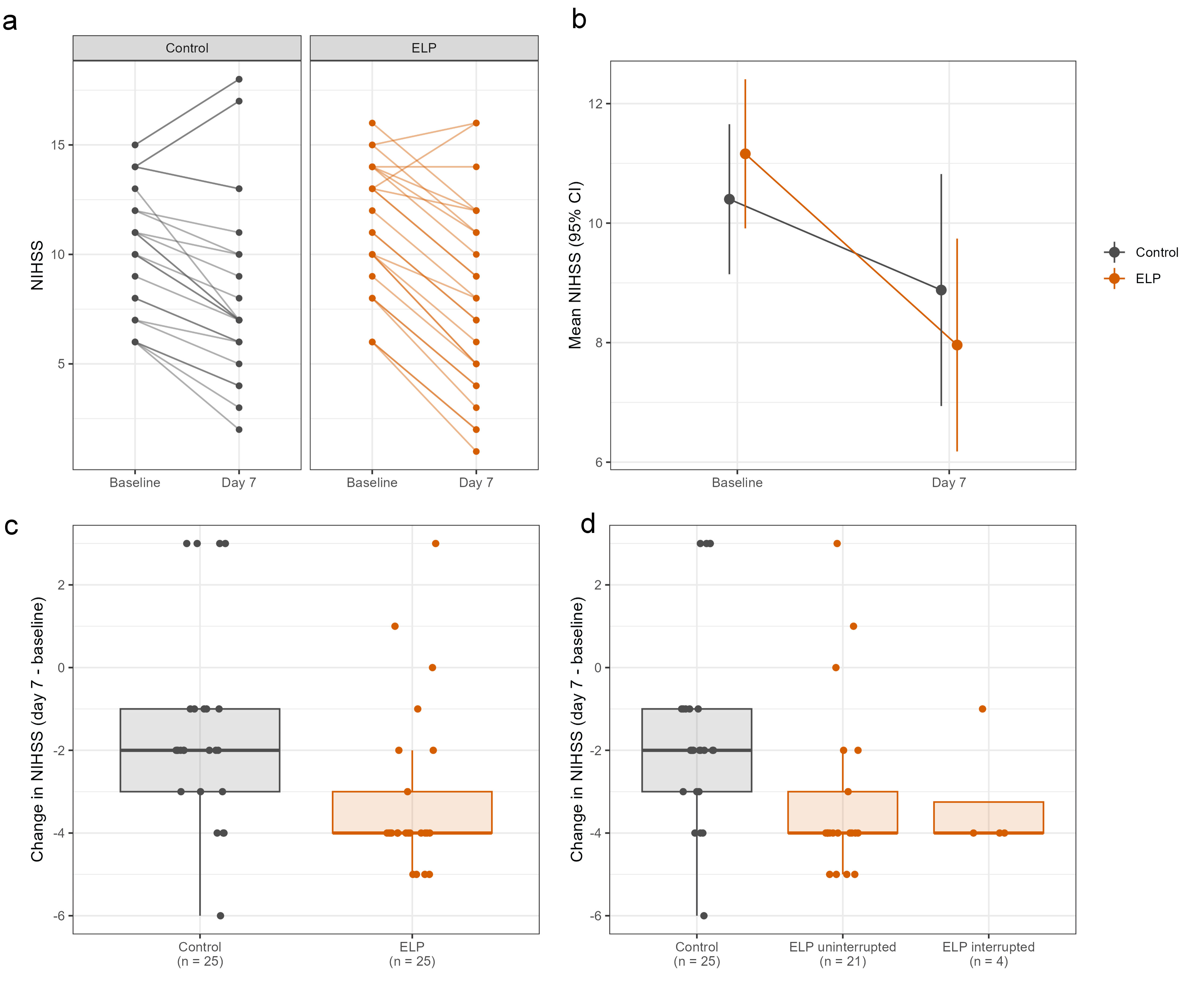
Results: Among the 50 participants, the mean baseline NIHSS score was slightly higher in the ELP group than in the control group (11.2 vs. 10.4). The unadjusted day-7 NIHSS score was 8.0 with ELP and 8.9 with control (difference, −0.92; 95% confidence interval (CI), −3.49 to 1.65). After adjustment for baseline NIHSS, the mean day-7 score was 7.45 (95% CI, 6.67 to 8.22) with ELP and 9.39 (95% CI, 8.62 to 10.17) with control (adjusted difference, −1.95; 95% CI, −3.04 to −0.85; P = 0.0008); sensitivity analyses yielded similar estimates (bootstrap 95% CI, −2.98 to −0.84). No episodes of early neurologic deterioration occurred in either group (0 of 25 participants). Among the 47 participants with 90-day follow-up data, which included seven patients who had died by 90 days (three in the ELP group and four in the control group), an mRS score of 0 to 2 occurred in 14 of 24 participants (58.3%) in the ELP group and 11 of 23 participants (47.8%) in the control group (risk difference, 10.5 percentage points; 95% CI, −16.9 to 35.8). Treatment was completed without interruption in 21 of 25 participants (84%) assigned to ELP.
Conclusions: In this exploratory analysis, treatment with ELP was associated with a lower adjusted day-7 NIHSS score compared with control. The unadjusted between-group difference was small and imprecise and estimates at 90 days were uncertain. The clinical importance of a 2-point difference in NIHSS score has not been established. These findings are hypothesis-generating and do not establish the efficacy or safety of ELP. A larger, blinded trial with a functional primary outcome is warranted.
Published
Issue
Section
License
Copyright (c) 2026 The authors

This work is licensed under a Creative Commons Attribution 4.0 International License.